In 1975, Mercedes-Daimler-Benz expanded the range of versatile working and towing machines with an additional heavy-duty series, the 425. Initially, the first model of the U425 carried the designation U120.
The series 425 and its angular cab
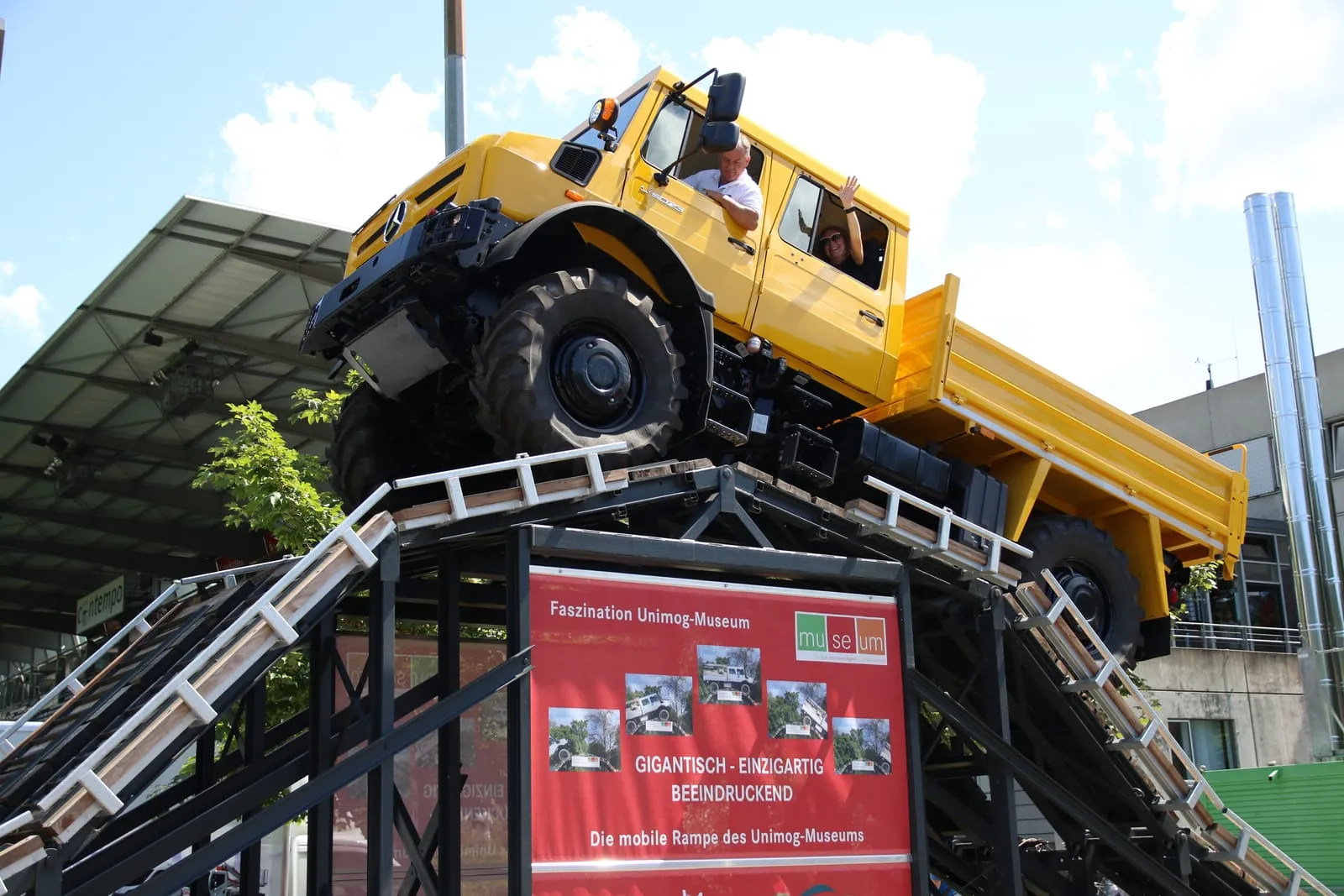
A defining feature of the series 425 is the design of its new angular cab. The brand-new short-bonnet cab, spacious and high-set with an angular look, offering a modern and functional workplace with a high level of driving comfort, is particularly striking. Its large bonnet, which barely slopes forward, makes it instantly recognisable. It ends with a wide black front panel. The basic appearance of this cab remained unchanged for more than a quarter of a century.
Three seats were also available on request. Vehicles of the first series were easily recognisable by their mirrors mounted only on the safety cab pillars.
The U120, later renamed the U1300
The first Unimog in the series 425 and the entry-level model was the U120.
Engine and transmission of the U120, U1300
Initially offered as an option alongside the naturally aspirated 120 hp engine. Very quickly, however, in January 1976, the U120 was fitted with a 125 hp six-cylinder 5.7-litre engine. This new engine uses the energy in the exhaust gases to force combustion air into the combustion chamber at an overpressure of approximately 0.7-0.8 bar. The advantages of this turbocharging were:
- higher specific power output,
- better combustion,
- more favourable fuel consumption,
- torque increased by 16%.
It was following the introduction of the turbocharged engine that the designation changed, and the U120 became the U1300.
As standard, the Unimog U1300 had an eight-speed gearbox. On request, it could be fitted with an additional planetary reduction unit providing eight further low-range gears.
Other technical features of the U1300
The Unimog series 425 was at the forefront with equipment such as:
- refined portal axles with disc brakes,
- Daimler-Benz power steering,
- a dual-circuit hydraulic braking system controlled by compressed air.
The U1300 had a wheelbase of 2,810 millimetres.
The Unimog U1500 with a larger engine
The U1500, initially called the U150, appeared shortly after the U1300. The engine developed 150 hp instead of the 125 hp of the U1300. The U1500 had a high load capacity, which allowed it to work economically even with the heaviest attachments, particularly in agricultural applications. Thanks to four-wheel drive, the U1500 could convert the power of its 150 hp engine into traction force with maximum efficiency.
Thanks to these characteristics, the uses of the U1500 multiplied and vehicles were purchased for agriculture, commerce, industry, and the public sector.
The front axle could be engaged while driving in a pneumatic operation, easily activated by a rotary knob. Using the same knob, also while driving and pneumatically, the differential could be locked on both the front and rear axles.
The U1500, which had evolved into a versatile and powerful road tractor intended for economical industrial use, was authorised to tow a 40-tonne trailer. This was twice as much as a truck, because under the law tractors only needed 3 hp/tonne, whereas trucks needed 6.
Comfort of the U1500
Particular emphasis was placed on creating a driver-friendly workspace:
- the noise level inside the safety cab was exceptionally low,
- the cab was fitted with a hydraulically height-adjustable seat,
- the space for the driver and co-driver offered a high level of comfort,
- an air conditioning system ensured low-dust, low-noise ventilation,
- the driver’s forward seating position, combined with the specially lowered bonnet, provided good road visibility,
- power steering and a small turning radius made difficult manoeuvres easier.
Unimog U1500 T
On this model, the Unimog power unit ended practically behind the driver’s cab and was fitted with standardised attachment points for use as a drive unit for special vehicles. The U1500 T was the most powerful version of the Unimog at the time. It could carry payloads of up to 8 tonnes with a tipping lift body.
Variants and model codes
| Model | Name | Cab type | Wheelbase | Power (hp) | Engine |
|---|---|---|---|---|---|
| 425.121 | U1300 | Closed cab | 2810 mm | 125 | OM 352A |
| 425.131 | U1500 T | Closed cab | 150 | OM 352A | |
| 425.141 | U1500 | Closed cab | 2810 mm | 150 | OM 352A |
Unimog U120 or U1300
Unimog U150 or U1500
Unimog U1500 T
Chassis 425 models
Photo credits: Mercedes-Benz AG