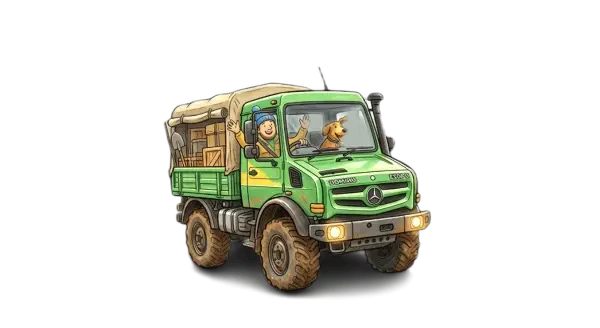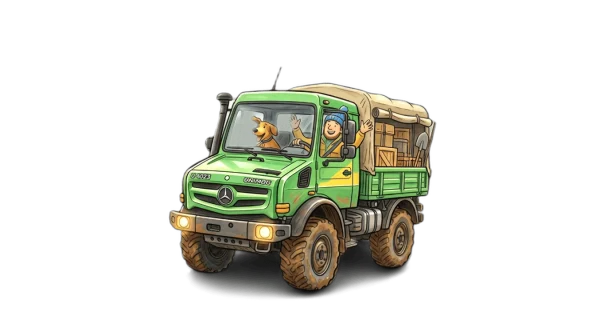
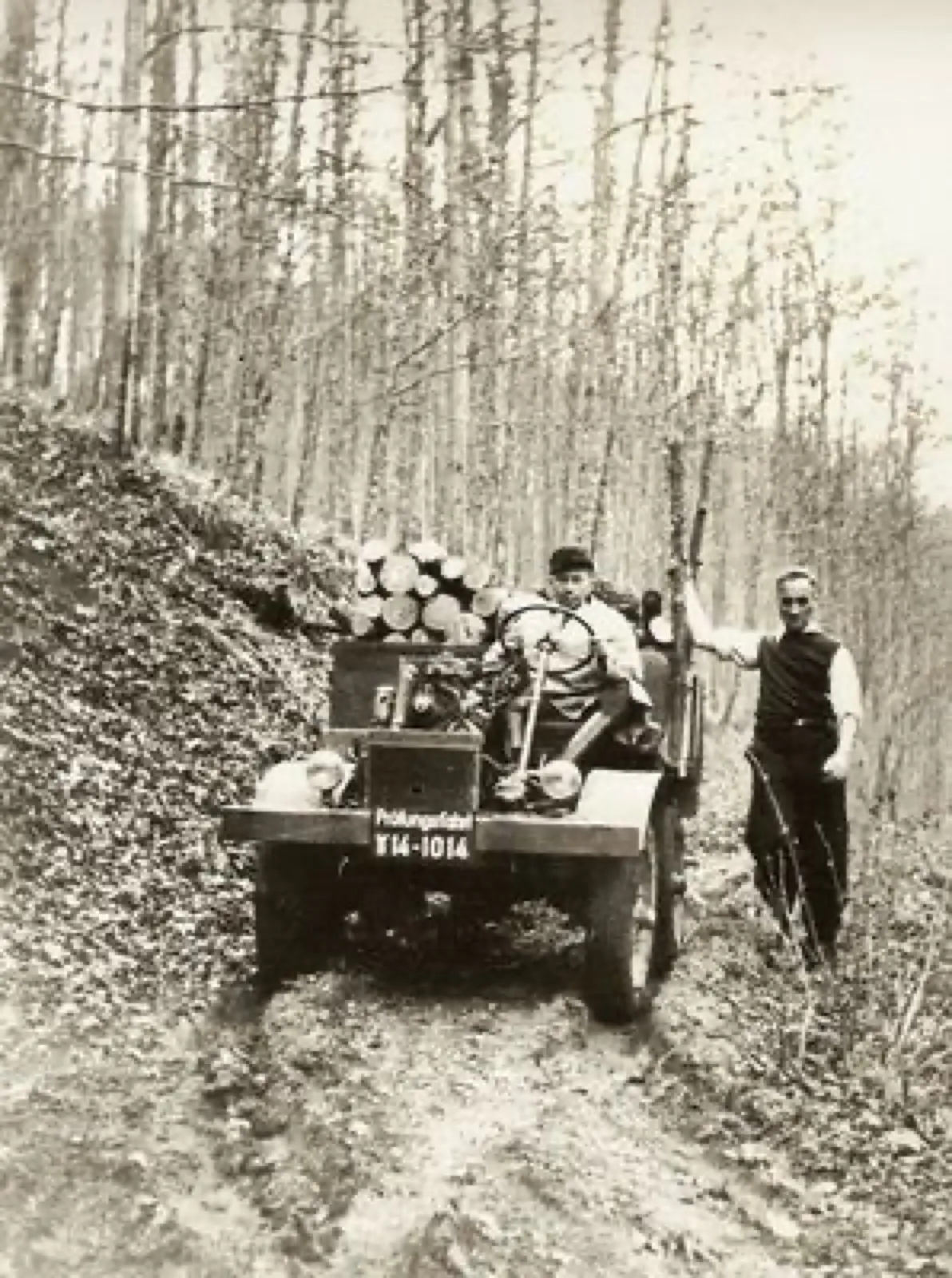
In 1946, the Unimog was born. To be precise, it was on Wednesday 9 October 1946 that prototype 1 of the Unimog completed its real-world driving trials. The history of the Mercedes-Benz Unimog thus begins in the obscurity of post-war Germany, with performance focused on meeting the needs of a starving country. A light model (3,500 kg), compact dimensions and off-road capabilities ready to face every situation.
The creation of the Unimog
You will notice that this first model was not final: it has no bonnet and was loaded with wood to assess its potential. Nevertheless, the test was a success.
Since October 1944, engineer Albert Friedrich had been developing at Daimler-Benz AG a concept for an agricultural vehicle capable of reaching the most inhospitable corners to improve field productivity in those difficult times. Food shortages were devastating the population, and the Unimog could help relieve the country’s distress.
Before joining the Unimog project, Albert Friedrich was responsible for developing aircraft engines at Daimler-Benz AG.
In June of the previous year, at the end of the war, Friedrich had arrived in Untertürkheim, Stuttgart, to help rebuild Daimler-Benz AG and, at the same time, to work on his idea for a motorised agricultural vehicle. The plans built on an old Daimler-Benz project for a four-wheel-drive vehicle dating from 1942.
4 August 1945
An engineer from Friedrich’s team prepared the first draft for immediate review.
7 September 1945
The Unimog sketches were presented to company management, which showed little interest in the motorised agricultural vehicle.
9 October 1945
The Unimog was presented to the Production Control Commission (the American military authority operating in this part of Germany).
This simple model was regarded as a truck because of its structure: a cabriolet double cab and a flatbed body at the rear. Fitted with a 25 hp petrol engine and a 6-speed gearbox. This all-terrain vehicle had one clear objective: to feed the German people. Its creator, Albert Friedrich, drew up his plans in response to the challenge of creating a truck that was useful for agriculture and robust, with a maximum load weight of around four tonnes.
From his mind emerged a light truck less than four metres long, with four-wheel drive and differential brakes on both axles. All of this, together with the provisions for hydraulic power take-offs, produced a multitalent capable of carrying anything, towing other platforms, ploughing and working in the fields, among other things. And it proved to be a true multitalent: a tractor ready for everyone, the fire brigade’s water tender and the perfect tool for hauliers.
New project leader for the Unimog
On 2 January 1946, Albert Friedrich handed over direction of the project to Heinrich Rößler. Within a few weeks, the project had been completely reworked, incorporating technical innovations that were crucial to the Unimog’s success. The engine and gearbox were positioned directly to the right of the vehicle’s longitudinal axis. In this way, the torsion bars protecting the drive shaft could form a right angle with the axles, meaning only four connection points to the chassis were needed. Between January and June, the technical definition of what is known as the UNIversal MOtor Gerät (meaning universal motorised implement) or UNIMOG was completed.
Technical characteristics of the first Unimog
It reached 50 km/h, twice the speed of a conventional farm tractor.
All its wheels are driven and it has a differential lock on the front and rear axles.
The brakes act on both axles (front and rear).
The chassis design brings it closer to modern cars and trucks.
In addition, its cab is covered and fitted with upholstered seats for two people; it has a loading compartment on the rear axle, allowing it to carry up to one tonne of all kinds of materials, wood, grain and so on; its weight distribution, 2/3 on the front axle and 1/3 on the rear axle, makes it stable even when fully loaded; and it is fitted with hooks on the sides, front and rear, useful for attaching as many additional implements as needed.
And the name Unimog appeared
Hans Zabel from Gaggenau, an engineer who had been part of the project from the start, named the vehicle. The Unimog was designed for agriculture, but it would soon be equipped with a large number of attachments and could then develop its full potential.
It was October 1946 and the Unimog was born, although some time still remained before it could reach its full market potential.
The first sale of a Unimog
The industrialisation of the vehicle at Gebr. Boehringer GmbH in Göppingen was a key development in the Unimog timeline. Having already manufactured components for prototypes 1 to 4, the traditional mechanical engineering company took over series production of the Unimog.
The first sale of the Unimog, as a motorised agricultural implement, at the annual fair of the German Agricultural Society (DLG) in 1948 took place under the name of the Göppingen-based company. The new product itself had been officially named the Unimog in November 1946.
Start of production at Gaggenau in 1951
Daimler-Benz AG’s takeover of the Unimog was the decisive step in the Unimog’s history, nearly 70 years ago. This decision by the Stuttgart car manufacturer saw Unimog production move from Boehringer to the Daimler-Benz AG truck plant in Gaggenau, a decision that allowed the universal agricultural machine to become, over more than 60 years, one of the world’s unique commercial vehicles.
After production started, the first U 2010 made in Gaggenau left the assembly line on 4 June 1951. This model series became an instant success for Mercedes-Benz.
In the first seven months of 1951, some 1,005 units were produced. The Gaggenau production site was far superior to the Göppingen plant, as Daimler-Benz AG had introduced assembly-line production in its factories back in 1936. The Gaggenau workforce tackled the task at a remarkable pace, going from zero to one hundred units in just six weeks. By comparison, Boehringer took two and a half years to build a total of 600 Unimog.
The model designation changed from U 70200 (Boehringer) to U 2010 (Mercedes-Benz). The trademark used by Boehringer for the Unimog, a distinctive ox head, was to remain on the bonnet until September 1955. From 1953, with the launch of the 401 series, the ox head was joined by the Mercedes star. On 12 August 1970, the 150,000th Unimog, a U 421, was officially presented as a donation to a charitable institution by Dr Hanns-Martin Schleyer, then a member of the Daimler-Benz Board of Management.
The evolution of the Unimog
Technical advances made it possible to improve the Unimog, and this vehicle could contribute to improving society in many other areas, from fire fighting to land exploration, from the world of transport to towing other vehicles.
In the mid-1950s, Unimog production grew with versions where a greater distance between the axles increased its load capacity, but it was in the mechanical field that the Unimog made the most progress: with coil spring suspension, a heavy-duty 24-speed transmission, 4x4 drive, but still with a petrol engine. At the time, the Unimog S404 already offered 82 hp, and around 70 hp, 110 hp with a 2.8-litre block. It is worth noting that both engines delivered remarkable output for the model’s size and weight.
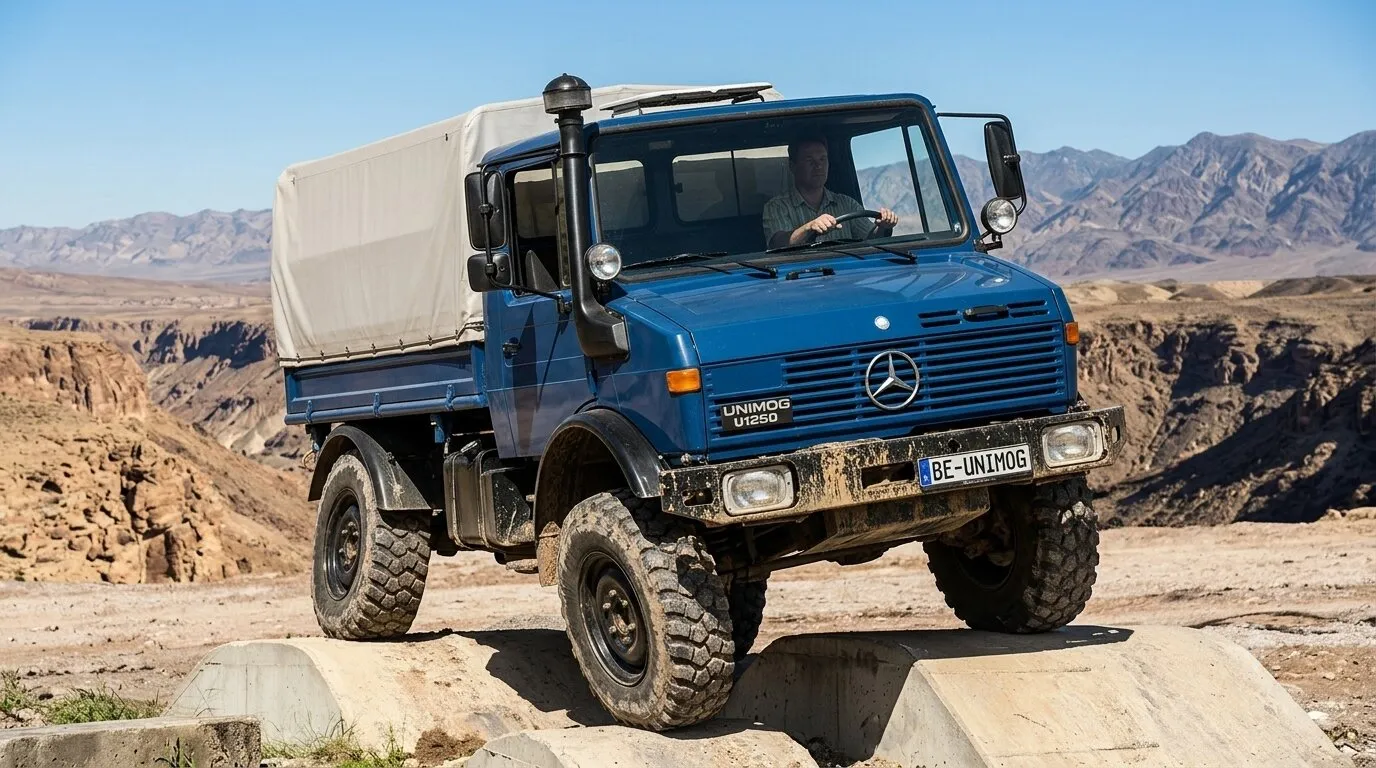
The Unimog U 1250 (424 series), Built from 1975 to 1993, the 424 series marked the Unimog’s move towards versatile heavy-duty vehicles. With its six-cylinder engine and increased payload, the U 1250 became a municipal implement carrier, fire-fighting vehicle and expedition machine, embodying the range expansion begun in the 1970s.
Other major developments of this all-terrain truck
U 216
156 hp, the largest in the family
U 404
U 406
U 411
U 416
U 421
U 530
With an engine still compliant with the Euro 6 standard offering a maximum output of 299 hp: the U 530 for agricultural use is used to form road combinations of up to 40 tonnes that can, for example, load sugar beet or potatoes in muddy fields close to the harvesting machine itself.
A paradigm shift
The applications and requirements of the Unimog changed over time. In 1996, the then Unimog product division of Mercedes-Benz AG took the decision to reinterpret the Unimog concept. Evolving customer needs in the market itself gave rise to new trends. It was no longer realistic to use a single vehicle model to meet all the requirements of a wide range of different customers, such as municipalities, trade, industry, the energy sector, fire services, agriculture and the military. The time had come to adopt a new approach: to draw a dividing line between the external off-road Unimog and a professional implement carrier. In order to provide an economically viable basis, both Unimog model series had to share 50% of common parts. In addition, cost-effective parts were used in the production of Mercedes-Benz trucks.
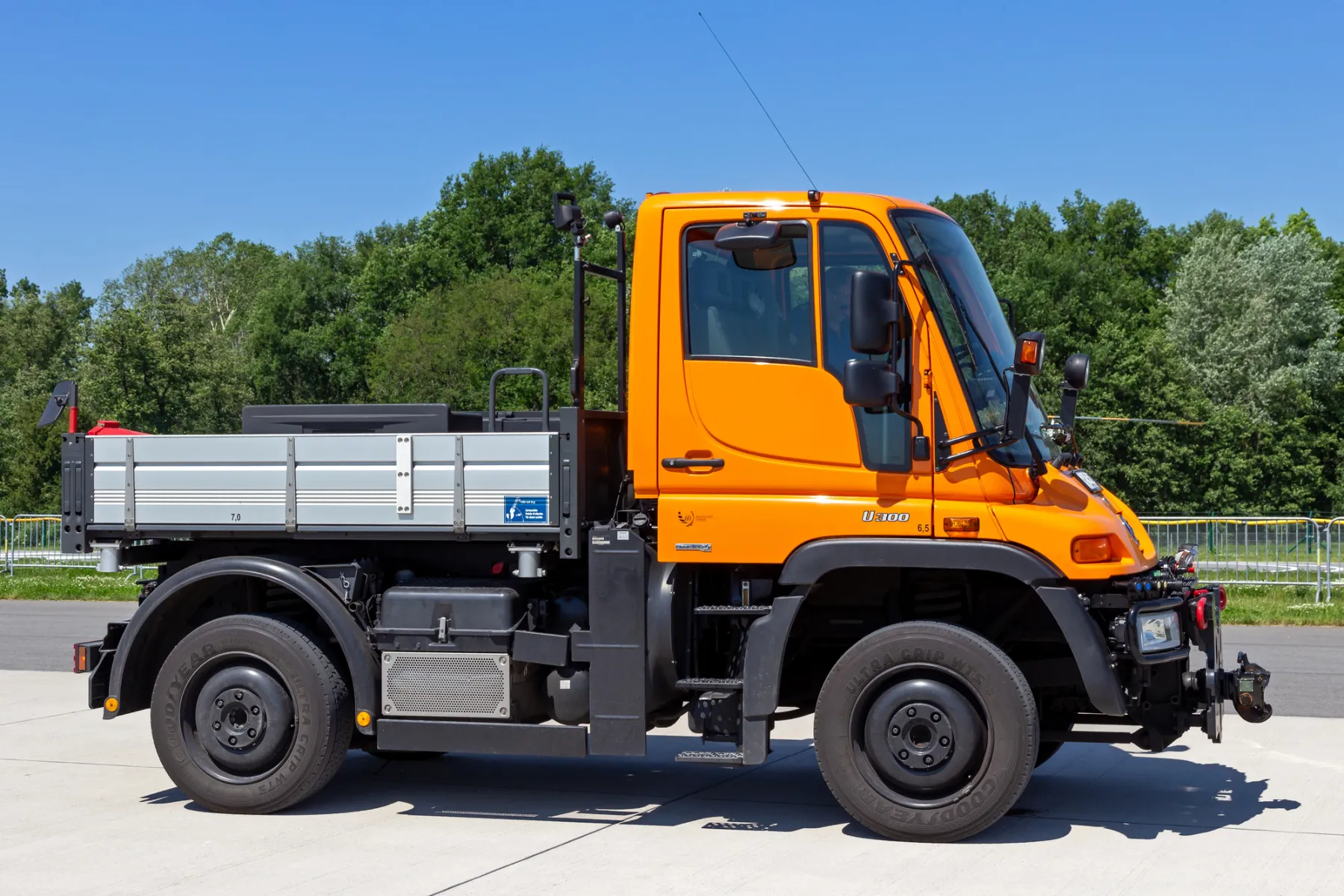
The implement carrier appears in 2000
The new Unimog implement carrier of the 405 series (U 300, U 500) was unveiled in 2000. From the mid-1990s, the question had arisen as to which concept offered customers the best possible advantages. The market was increasingly demanding economically optimised implement carrier systems with a single operator.
The answer: the Unimog U 300 / U 400 / U 500 with short cab, large windscreen, integrated mechanical and hydraulic drive and optional bi-modal VarioPilot steering. This function allows very rapid switching from right-hand drive to left-hand drive steering column, dashboard and controls, or vice versa.
The design of this model series, with its low waist rail and short, steeply raked windscreen and bonnet providing an unobstructed view of the vehicle, the attached implements and their attachment points, still characterises the appearance of the Unimog implement carrier today.
Unimog production leaves Gaggenau in 2002
At the time of the relocation of Mercedes-Benz Unimog production in 2002, Gaggenau had already developed no fewer than 27 model series, with total sales exceeding 320,000 units. With a total of 64,242 units, the 404.1 series, the petrol-engined Unimog S, was the best seller, with the German armed forces alone ordering around 36,000 units.
The move from Gaggenau to the Mercedes-Benz truck assembly plant at Wörth am Rhein marked the fifth chapter in Unimog history. To achieve this, 6,000 tonnes of stock and 2,600 pieces of equipment, totalling more than 34,000 items, had to be shipped the 48 kilometres across the Rhine to Wörth, in the German state of Rhineland-Palatinate. A total of 480 trucks were needed to move the dismantled Gaggenau installations to Wörth. The Group’s largest truck plant met all the logistical requirements for optimum vehicle production. Production started on 26 August 2002. The shared use of logistics areas, paint shops, training and maritime equipment departments, and personnel facilities resulted in a significant increase in revenue.
These unique characteristics, combined with high quality standards, were the key to the Unimog’s success. Just two years after the new implement carrier, the new generation of the extreme all-terrain Unimog (series 437.4) for fire services, the energy industry and transport arrived with the U 3000-U 5000 models. This new extreme all-terrain Unimog was equipped with a completely new transmission while retaining the face of the Unimog (SBU) series, which had been launched in 1975 with the 425 series (U 1300, U 1500, U 1500 T).
The first model series developed in Wörth was the U 20 (2007-2013), a compact municipal implement carrier completing the entry-level range, which was replaced in 2013 by the U 216 / U 218 models.
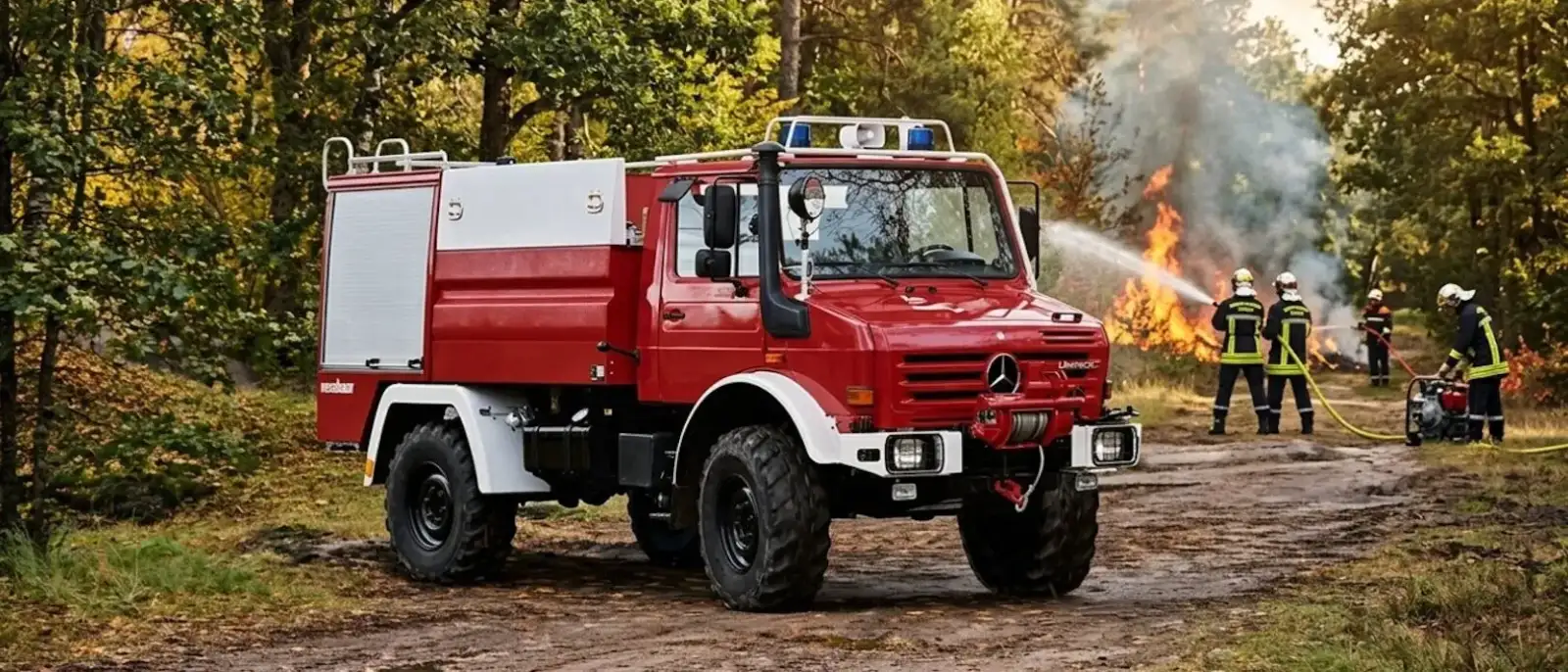
Unimog BlueTec 6
In 2013, as part of the introduction of the Euro VI emissions standard, the latest Unimog BlueTec 6 implement carriers were launched. They carry the model designations U 216, U 218, U 318, U 423, U 427, U 430, U 527 and U 530.
The new generation of the extreme all-terrain Unimog BlueTec 6 carries the designations U 4023 and U 5023; the new BlueEfficiency engines from the OM 934, OM 934 LA and OM 936 LA series with four and six cylinders and power outputs between 115 kW (156 hp) and 220 kW (299 hp) combine low fuel consumption with effective emissions control to Euro VI standards.
Unimog nomenclature
The nomenclature, that is the system of names and numbers used for model designations over the 60 years of the Unimog, cannot be explained by any consistent mathematical logic. Terms such as model variants, sales designations and abbreviations such as LBU (for the light series), MBU (medium series) and SBU (heavy series) alternate with designations that were progressively phased out.
Since its launch within the Daimler Group, the Unimog designation has remained the same: the initial “4” in all Unimog model series.
To date, there have been 30 Unimog model series (including the Boehringer Unimog 70200) with more than 260 model variants.
Excluded are the model series manufactured under licence in Argentina (U 431 and U 426) and Turkey (U 436), the tractor for the US Army (U 419) and the U 405 (SH) prototype with rear engine.
Unimog, the off-road pride of the star brand
Few vehicles can display their star with such pride, history and character. The Unimog concept has evolved both mechanically and in terms of usage, turning the model into an off-road vehicle with unsuspected limits.
Photo credits: Mercedes-Benz AG