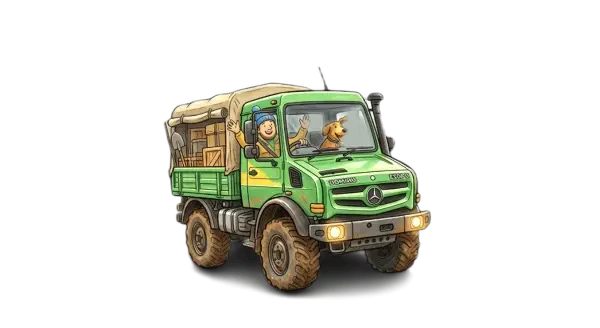
Production of the series 435, intended for the Bundeswehr, began in 1975, as with the series 425, to succeed the Mercedes-Benz Unimog 404, also known as the Unimog S. The U1300 L and the U1700 L were primarily intended to meet the Bundeswehr’s transport needs in the 2-tonne class.
In 1988, the series was replaced by the series 437.
The cab of the Unimog series 435
As with the series 425, a new arrangement of the drive units gave the 435 a modern, very spacious all-steel cab with a new angular design, capable of accommodating three people.
This Unimog was also characterised by a long wheelbase of 3,250, 3,700, or even 3,850 millimetres.
Engines of the U1300 L and U1700 L
For the first time, a Unimog broke through the 100 km/h barrier. With a top speed of 105 km/h, the U1300 L was even faster for road transport tasks. This was due to the engine performance:
- The U1300 L was powered by a naturally aspirated 130 hp engine (BM 353.961).
- The U1700 L was fitted with a six-cylinder turbocharged diesel engine producing 168 hp (BM 353.959).
Unimog U1700
In addition to the Unimog U1300 L (BM 435.115) and U1700 L (BM 435.113) models, built from September 1975 as high-capacity off-road vehicles adapted to market requirements, the series 435 was complemented in 1979 by the U1700 (BM 435.110), the most powerful long-wheelbase tractor and working machine of the range. The new implement carrier with a 5-tonne payload and considerable towing capacity was fitted, like the U1700 L, with a six-cylinder 168 hp turbocharged diesel engine (BM 353.959).
The Unimog at the Paris-Dakar Rally
The fourth Paris-Dakar Rally took place in 1982. After more than 10,000 km spread over 20 days of racing, the Unimog achieved a one-two finish. In the truck category, a team on a U1700 L took the victory, closely followed by a U1300 L in second place.
The Unimog again proved its superiority at the 1985 Paris-Dakar Rally. The private Capito team from Siegerland won the raid rally with a 180 hp U1300 L capable of reaching 125 km/h.
Variants and model codes
| Model | Name | Cab type | Wheelbase | Power (hp) | Engine |
|---|---|---|---|---|---|
| 435.110 | U1700 | Closed cab | 3250 mm | 168 | OM 352A |
| 435.111 | U1700 L | Closed cab | 3250 mm | 168 | OM 352A |
| 435.113 | U1700 L | Closed cab | 3850 mm | 168 | OM 352A |
| 435.115 | U1300 L | Closed cab | 3250 mm | 130 | OM 352 |
| 435.117 | U1300 L | Closed cab | 3700 mm | 130 | OM 352 |
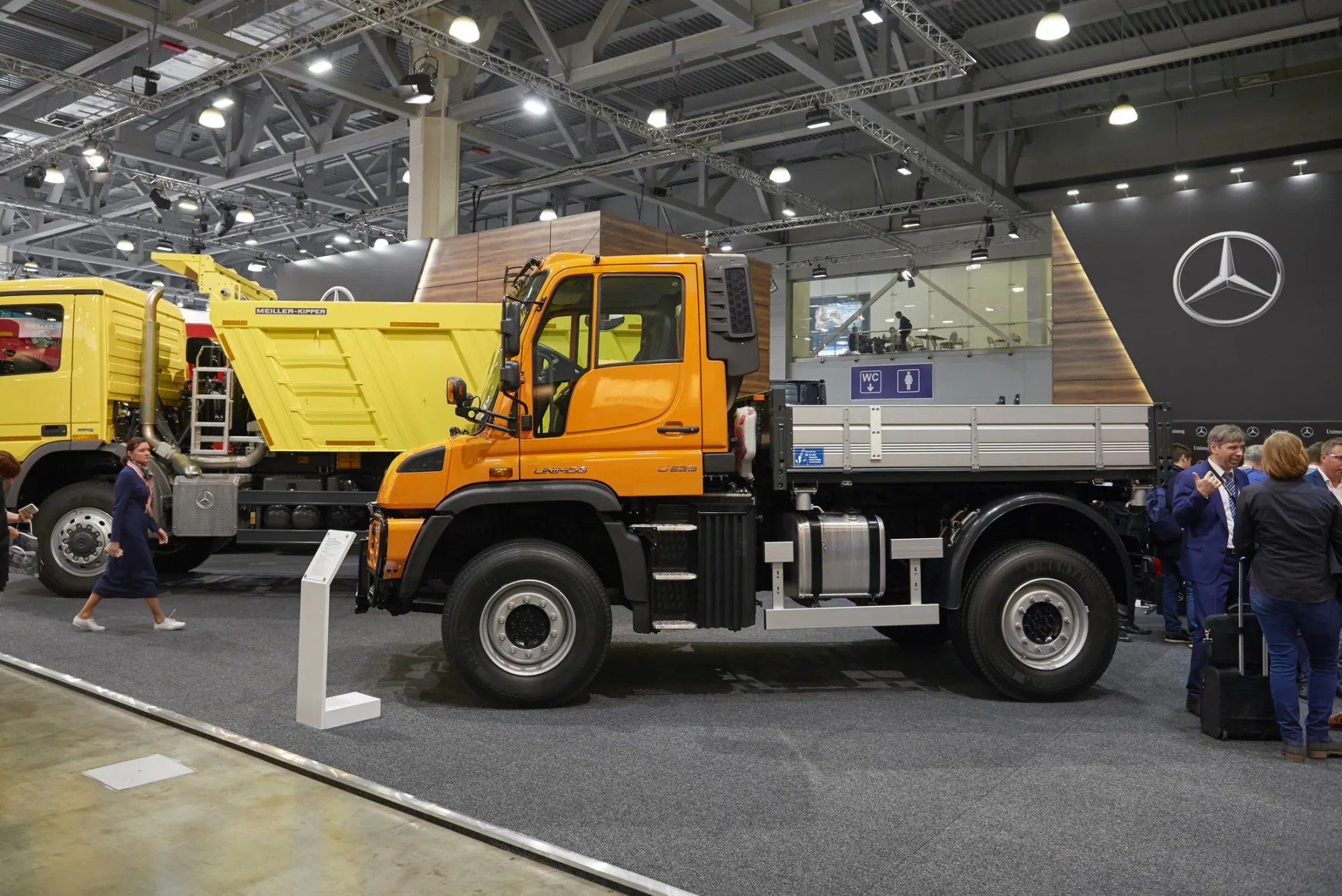
Photo credits: Mercedes-Benz AG