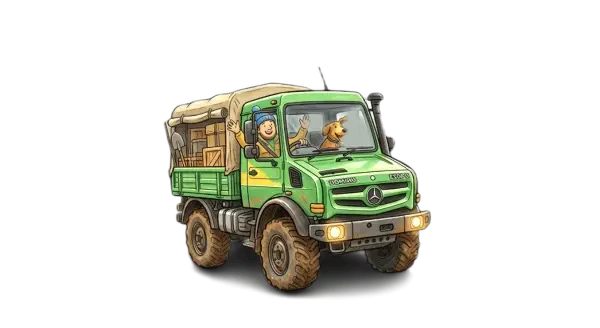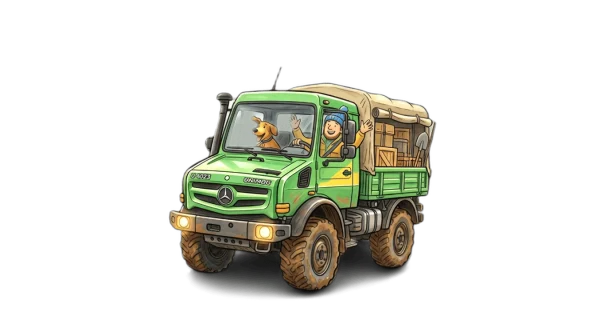
The Unimog series 427 succeeds the previous heavy-duty models, the series 424 and 425. The Unimog 427 series was positioned at the top of the Unimog range. It was designated by Mercedes for heavy-duty work and is therefore referred to as the SBU. At that time, the other series on the market were the series 407, known as the LBU (light series), and the series 417, the MBU (medium series).
The cab of the series 427
- The series 427 is characterised by a spacious and practical driver’s cab. The two-seat cab was equipped with:
- a three-point suspension,
- impressive sound insulation,
- large windows,
- practical, work-oriented standard equipment including heating, ventilation, and comfortable seats.
The cab can be tilted for maintenance work. It was available with three seats or as a double cab seating seven people. Under the folding rear bench of the double cab were three storage compartments in which tools and other equipment could be carried. The driver’s workstation was designed according to the latest ergonomic principles. There was plenty of space between the seat and the steering wheel. The instrument panel, designed using the proven transmitted-light technique, is distinguished by a clear arrangement of warning indicators.
The series 427 is defined by its many variants
The Unimog 427 was offered in a large number of variants, both as a tractor and as a working machine. Customers could choose between short and long wheelbase.
In terms of use, the Unimog 427 series could be seen either as a premium off-road vehicle or as a power unit capable of carrying a wide variety of attachments and special bodywork for countless applications.
Short-wheelbase Unimog 427 models
These models have a short wheelbase of 2,650 mm:
- The U1000 was the smallest model in the series 427 and therefore the least expensive variant in the entire 427 range. Its engine produced 102 hp.
- The U1200 was a working and towing machine.
- The U1400, with its engine developing 136 hp and later 156 hp. This Unimog was also sold in an Agrar version.
- The U1600 initially received a 156 hp engine. From 1992 onwards, a six-cylinder turbocharged diesel with charge-air cooling, producing 214 hp, was used.
These models were used by municipal services as manoeuvrable four-wheel-drive working machines. The quick-change attachment system allowed any changeover to be carried out rapidly. These advantages allowed the Unimog to find a wide range of applications in the municipal sector.
- During the summer months, mowing was one of the main tasks of the Unimog.
- In winter, winter services have always meant snow clearance. Thanks to the Unimog’s tool-locking system, even large front-mounted implements such as snow ploughs or snow blowers can be picked up quickly by a single person and manoeuvred safely through the narrowest streets in city centres. The Unimog for winter service could also be fitted with a hydrostatic drive, which allowed continuous switching between forward and reverse and considerably increased manoeuvrability, working speed, and therefore the area output of the four-wheel-drive machine.
- In every season, the Unimog has become an indispensable tool for certain tasks, such as street cleaning including during sensitive hours, thanks to the noise reduction measures introduced on the Unimog 427 and 437 series, which reduced the noise level to 78 dB.
Changes in the agricultural industry forced a combination of agricultural and municipal use. Multi-purpose use is now at the forefront. Thanks to its Terra tyres, the series 427 demonstrated its performance as a four-wheel implement carrier not only in winter, but also in spring, summer, and autumn when plants and soil needed to be protected. The automatic position regulation based on load, provided by the Terramatic control hydraulics, always maintained the same distance between the spreader disc and the ground.
The series 427 was also available with the Tirecontrol tyre pressure monitoring system, which could be operated directly from the driver’s cab via a screen. With this system, the pressure in all four tyres can be reduced simultaneously for soil work and raised again for road transport without the driver having to stop.
Long-wheelbase Unimog 427 models
The wheelbase was 3,250 mm. The models in this category are:
- the U1250,
- the U1450,
- the U1650.
These models had plenty of room for a large loading platform.
Off-road Unimog 427 models
- the U1250 L,
- the U1450 L,
- the U1650 L.
The letter L identified the off-road variants. These Unimogs could quickly reach the rails and drive on them, both on the road and on construction sites often located off the beaten track. However, in rail-road configuration, the dual-mode device with its retractable rail guide was an essential prerequisite for the Unimog to move on the rails. And if work on and around the track had to be interrupted due to planned rail traffic, the Unimog cleared the tracks again within minutes. To optimise the drivetrain, the off-road Unimog was equipped with a torque converter clutch (WSK).
Power unit variants
The U1200 T and U1400 T rounded off the Unimog series 427 range.
These versions had become indispensable as the basis for tailor-made solutions to the most varied transport tasks: whether for internal heavy-load transport, as a special 6x4 or 6x6 all-terrain vehicle with particularly high payloads, or as a special vehicle for underground use.
Fitted as standard with a drive flange for the rear axle, the Unimog power unit could be converted into a manoeuvrable and fast 4x4 semi-trailer tractor. With a hydraulically height-adjustable fifth-wheel coupling and towed loads of up to 20 tonnes, the Unimog was used as a semi-trailer tractor for transport tasks in container terminals as part of roll-on/roll-off traffic worldwide.
The Urban Unimog
The Japanese launched a new development in the Unimog range. The Urban Unimog was created in Japan as an urban and leisure vehicle. These vehicles were used to transport all kinds of sports equipment such as motorcycles. In addition to a high-quality car-like interior, it was the use of chrome and stainless steel for the front section and the multi-part tubular frame behind the driver’s cab, together with the metallic paint, that distinguished the Japanese leisure Unimog U1400 from the working models.
Variants and model codes
| Model | Name | Cab type | Wheelbase | Power (hp) | Engine |
|---|---|---|---|---|---|
| 427.000 | U1200 T | Closed cab | 125 | OM 366A | |
| 427.100 | U1000 | Closed cab | 2650 mm | 102 | OM366 |
| 427.101 | U1200 | Closed cab | 2650 mm | 125 | OM 366A |
| 427.102 | U1400 | Closed cab | 2650 mm | 136/156 | OM 366A |
| 427.105 | U1600 | Closed cab | 2650 mm | 136/156 | OM 366A |
| 427.107 | U1600 | Closed cab | 2650 mm | 180/214 | OM 366LA |
| 427.110 | U1250 | Closed cab | 3250 mm | 125 | OM 366A |
| 427.111 | U1250 L | Closed cab | 3250 mm | 125 | OM 366A |
| 427.112 | U1450 | Closed cab | 3250 mm | 136 | OM 366A |
| 427.115 | U1650 | Closed cab | 3250 mm | 136/156 | OM 366A |
| 427.116 | U1650 L | Closed cab | 3250 mm | 156 | OM 366A |
| 427.117 | U1650 | Closed cab | 3250 mm | 180/214 | OM 366LA |
| 427.118 | U1650 L | Closed cab | 3250 mm | 180/214 | OM 366LA |
Unimog U1400
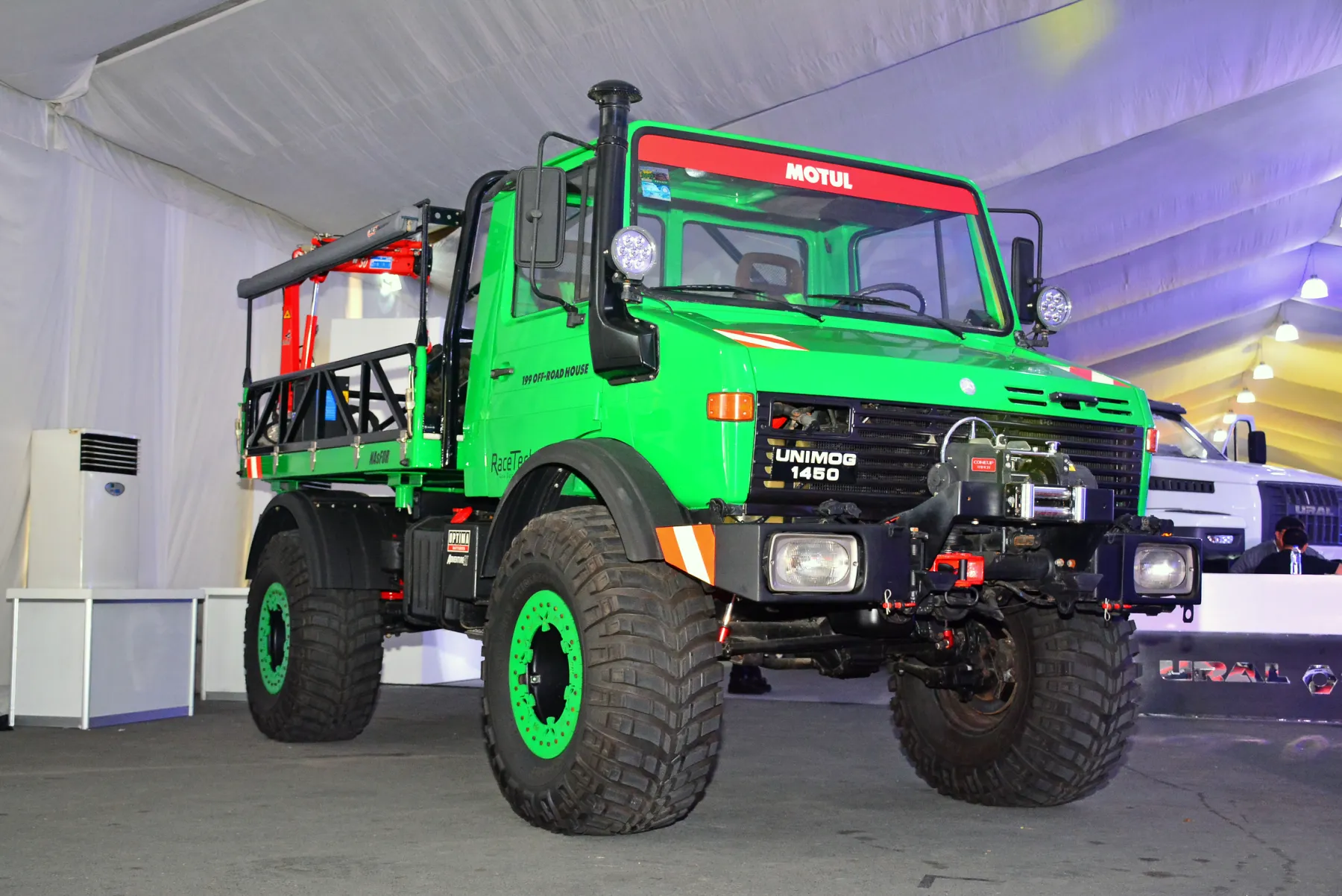
Unimog U1450
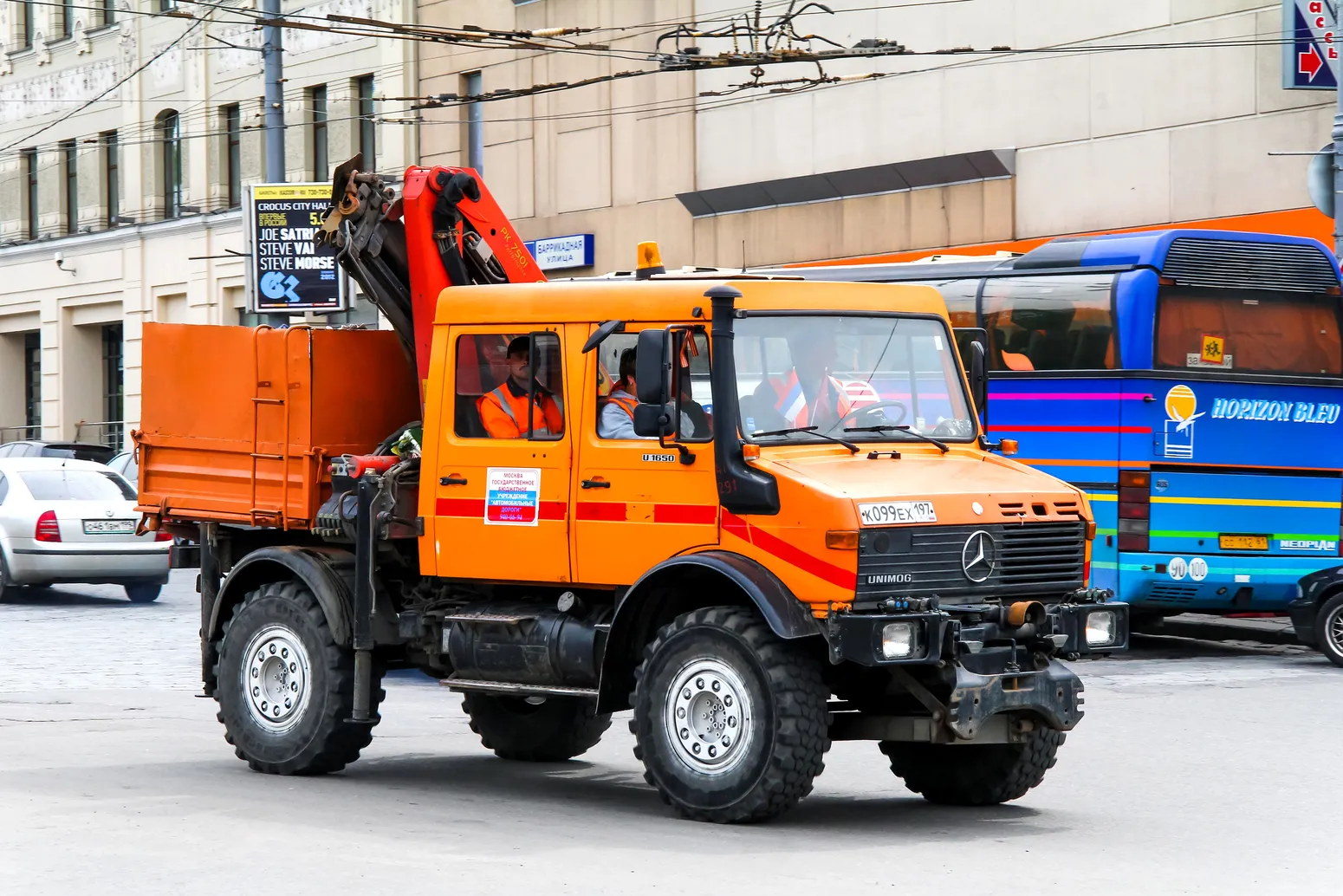
Unimog U1650
Photo credits: Mercedes-Benz AG