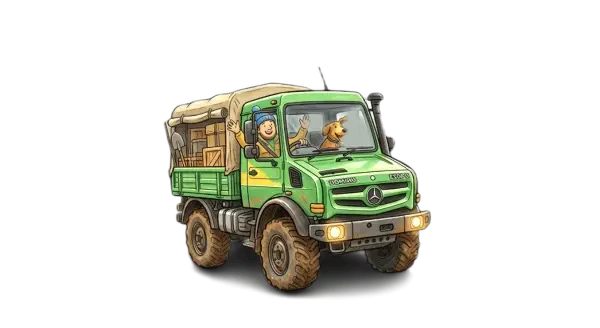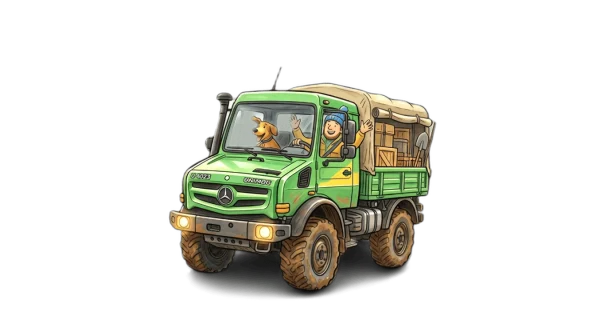
The Unimog U1000 of the series 424 was introduced to complement the series 425 in the second half of 1976. This model marked the milestone of the 200,000th Unimog to roll off the Gaggenau production line.
Uses of the U1000
The U1000 was put to many different uses, as it is a versatile vehicle thanks to a wide range of attachments and short changeover times.
The U1000 was powered by a 6-cylinder engine producing 95 hp.
For municipalities and local councils
The U1000 was designed as an implement carrier. It was therefore sold primarily to local and municipal authorities. Its main tasks were snow clearance and road cleaning.
Agricultural use of the U1000
The U1000 was also used in farming. It was a robust four-wheel-drive tractor with a modern, very spacious cab.
The U1000 T and U1200 T
The U1000 T model went on sale in January 1979. It received the 110 hp engine from the 416. Its features are those of the series 424: a fully redesigned all-steel cab with a modern look and a standard eight-speed gearbox with a wide range of ratio options.
A wide range of equipment and accessories was available, making the U1000 T a successful transport concept for special tasks, for example in combination with a low-loader pallet truck. As a low-floor pallet truck, the U1000 T stood out for its low transport costs, particularly on short and medium-distance runs. It offered loading possibilities at ground level or continuously adjustable to any ramp height, in combination with interchangeable loading areas that could be supplied with a platform or as a box, depending on the intended use.
In January 1983, the U1200 T replaced the U1000 T. The U1200 T was used for special tasks by subcontractors, converted into a tipping lift truck, a low-floor truck with interchangeable loading areas, or a container loader. As a tractor, it could carry up to 6.1 tonnes of payload.
The particular strength of the U1200 was evident in agricultural applications, heavy tillage work, and seedbed preparation across large working areas. The substantial power reserves of this modern four-wheel-drive tractor were decisive in this regard. The four-wheel drive, differential locks, and engine power take-off at 540 and 1,000 rpm were also controlled by the standard compressed-air system. The spacious all-steel cab and good visibility over the tool-mounting areas not only made work easier but also increased safety. The dual-circuit hydraulic disc brakes with pneumatic assistance, automatically adjusted to the load, provided an additional safety benefit.
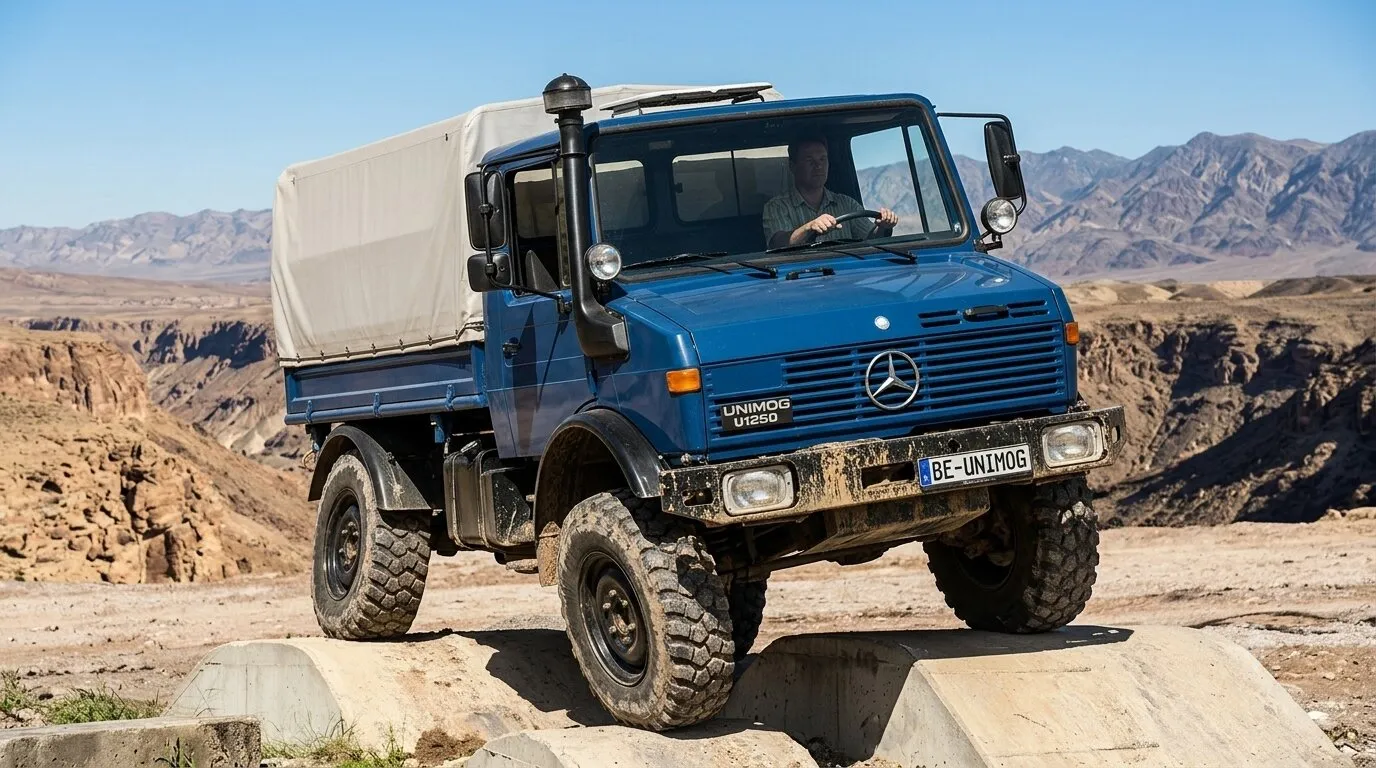
Unimog U1250
The Unimog U1250 was launched in May 1984. Compared to the U1200, the U1250 has a wheelbase of 3,250 mm, which is 600 mm longer.
The “fifty” designation in the model name was reserved for long-wheelbase working machines. The U1250 was therefore intended for use as an implement carrier, tractor, and transport vehicle. It combines the typical characteristics of the proven implement carrier with the transport capacity of a 7.5-tonne four-wheel-drive truck, which can still be driven on a class 3 driving licence.
The long 3,250 mm wheelbase provided plenty of room for the loading platform or larger superstructures. Unlike truck-derived equipment carriers, the U1250 remained a full working machine in its own right.
It was fitted with a turbocharged engine developing 125 hp. The high axle loads front and rear allowed heavy and powerful tools to be attached and fitted. Several implements can be driven simultaneously thanks to the front, centre, and rear power take-off shafts and a powerful hydraulic system.
Unimog U1550
The 150 hp U1550 rounded off the top of the series 424 range. It combines the typical characteristics of the implement carrier with a particularly high transport capacity on a 3,250 mm wheelbase.
Its permissible gross weight was 10,500 kg, making it suitable for use with particularly heavy tools, for snow clearance, or as a chassis for quick-change sweepers. The long wheelbase provides plenty of room for large loading platforms and additional accessories. Even with a double cab, there was still enough room for accessories and a loading area.
In 1986, the U1550 L chassis variant, with its high off-road capability, complemented the U1550 as a long-wheelbase tractor and working machine.
The U1550 benefited from improvements introduced by Mercedes in 1987, covering:
- acoustic insulation of the engine and drivetrain,
- a new fan and an exhaust system with additional sound insulation,
- further specific measures that reduced the noise level to 78 dB(A).
The U1550 also benefited from an ecological innovation. It was the first time a winter service vehicle had distinguished itself through a special process that reduced the amount of salt used for spreading by more than half.
The design maturity of the series 424 meant it was not replaced by the series 427 until twelve years later, in 1988.
Variants and model codes
| Model | Name | Cab type | Wheelbase | Power (hp) | Engine |
|---|---|---|---|---|---|
| 424.121 | U1000 | Closed cab | 2630 mm | 95 | OM 352 |
| 424.122 | U1200 | Closed cab | 2650 mm | 125 | OM 352A |
| 424.126 | U1250 | Closed cab | 3250 mm | 125 | OM 352A |
| 424.126 | U1550 | Closed cab | 3250 mm | 150 | OM 352A |
| 424.127 | U1250 L | Closed cab | 3250 mm | 125 | OM 352A |
| 424.127 | U1550 L | Closed cab | 3250 mm | 150 | OM 352A |
| 424.131 | U1000 T | Closed cab | 110 | OM 352 | |
| 424.132 | U1200 T | Closed cab | 125 | OM 352A |
Unimog U1250
Unimog U1550
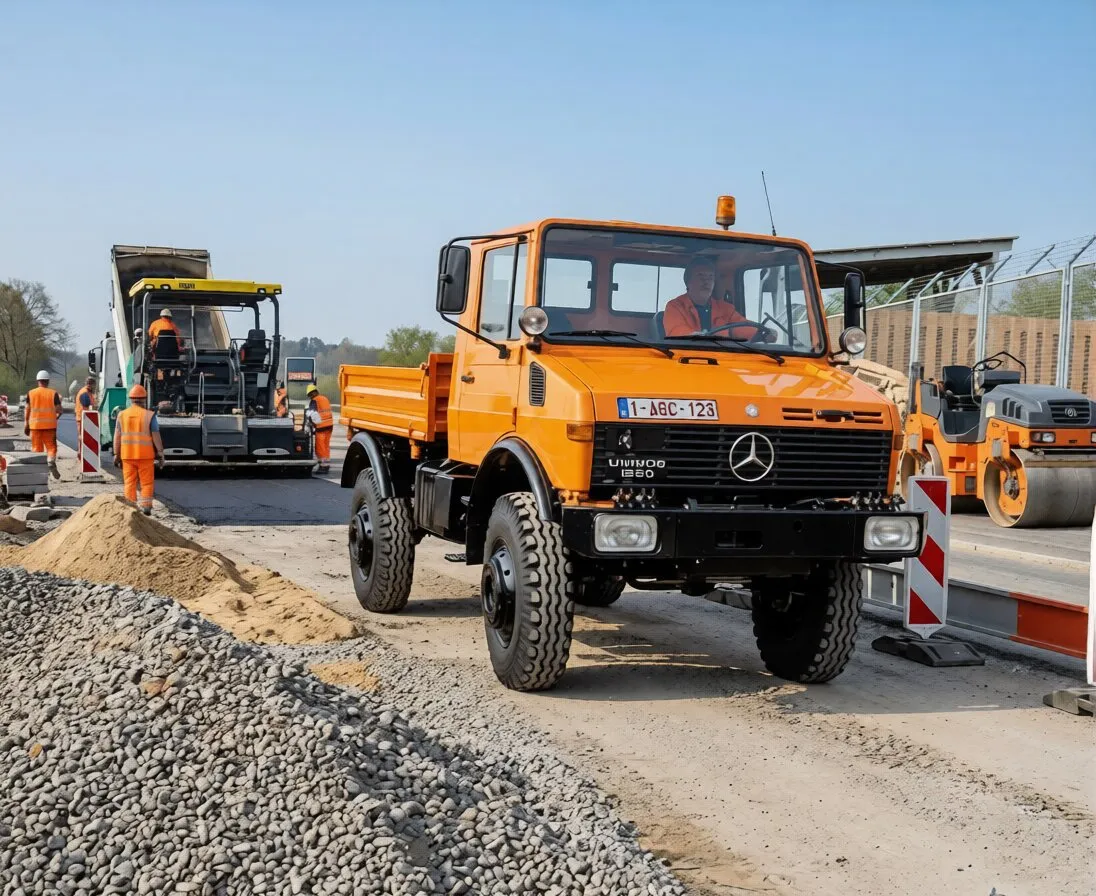
Unimog U1550 winter service
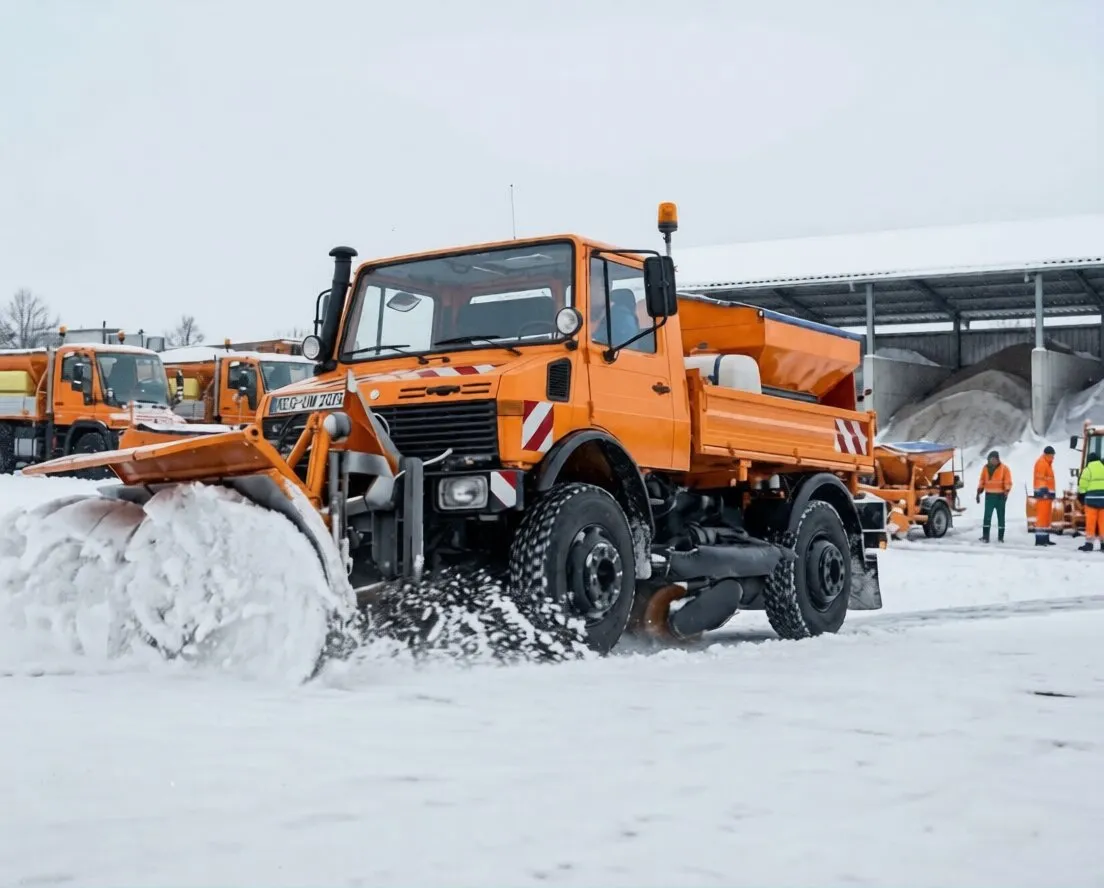
Photo credits: Mercedes-Benz AG