The Unimog 407 series was exhibited to the public for the first time in Munich, at the municipal vehicle trade show, in 1987. The defining characteristic of this series is its light weight.
The Unimog 407 is a compact, lightweight and economical work machine. It was designed to be used wherever powerful, versatile vehicles were needed regardless of conditions. The strengths of these vehicles lay in being small and manoeuvrable, offering a well-balanced combination of operating space, track width and stability.
The 407 series succeeded the 421 series, which had been in production since 1966. The easiest way to tell the 407 apart from the U 421 is the position of the intake manifold: on the 407 it is on the left side, while on the 421 it is on the right.
Models in the Unimog 407 series
The 407 series was offered in three variants:
- the U 600 (BM 407.100) with a short wheelbase (2,250 mm),
- the U 650 (BM 407.110) as a “long-wheelbase work machine” (2,605 mm),
- the U 650 L (BM 407.111) as an “all-terrain vehicle”, particularly suited to special bodywork thanks to its long wheelbase (2,605 mm).
Powertrain and transmission of the Unimog 407 series
The 407 series was powered by the four-cylinder diesel engine type OM 616. On the U600, its output was limited to 52 hp; it was subsequently raised to 60 hp for the U650 and U650 L.
A new fully synchronised transmission with helical gearing and pneumatic range-change shifting was fitted to this light series. It offered eight forward gears and four reverse gears.
This new transmission featured:
- smoother operation and reduced surface pressure thanks to the helical gearing,
- optimised gear ratios,
- precise and short gear-change travel,
- easy and fast gear changes,
- fully synchronised shifting,
- improved manoeuvrability through pneumatic intermediate gear changing.
All models in the 407 series were also equipped as standard with dual-circuit hydraulic drum brakes.
Comfort, styling and ergonomics of the 407 series
The chassis was redesigned with a reinforced standard front axle suspension. An additional stabiliser bar contributed to improved handling. Steering geometry was also optimised through modifications to the axle and chassis components.
The 407 series was available only in closed-cab form. The 1970s cab was retained but modernised, and was revised and updated for the light and medium Unimog series in 1988. The cab was raised by 160 mm and the windscreen enlarged by 25%.
The larger interior and increased headroom, combined with significantly improved control ergonomics and a more effective new heating and ventilation system, gave the driver a workstation suited to the demands of a modern work machine. The overall positive impression was further reinforced from a safety standpoint by improved access to the cab and by the enlarged windscreen and exterior mirrors.
Variants and model codes
| Model | Name | Cab type | Wheelbase | Power (hp) | Engine |
|---|---|---|---|---|---|
| 407.100 | U600 | Closed cab | 2250 mm | 52/60 | OM 616 |
| 407.110 | U650 | Closed cab | 2605 mm | 60 | OM 616 |
| 407.111 | U650 L | Closed cab | 2605 mm | 60 | OM 616 |
| 407.200 | U600 | Closed cab | 2250 mm | 52/60 | OM 616 |
| 407.210 | U650 | Closed cab | 2605 mm | 60 | OM 616 |
| 407.211 | U650 L | Closed cab | 2605 mm | 60 | OM 616 |
Unimog U600
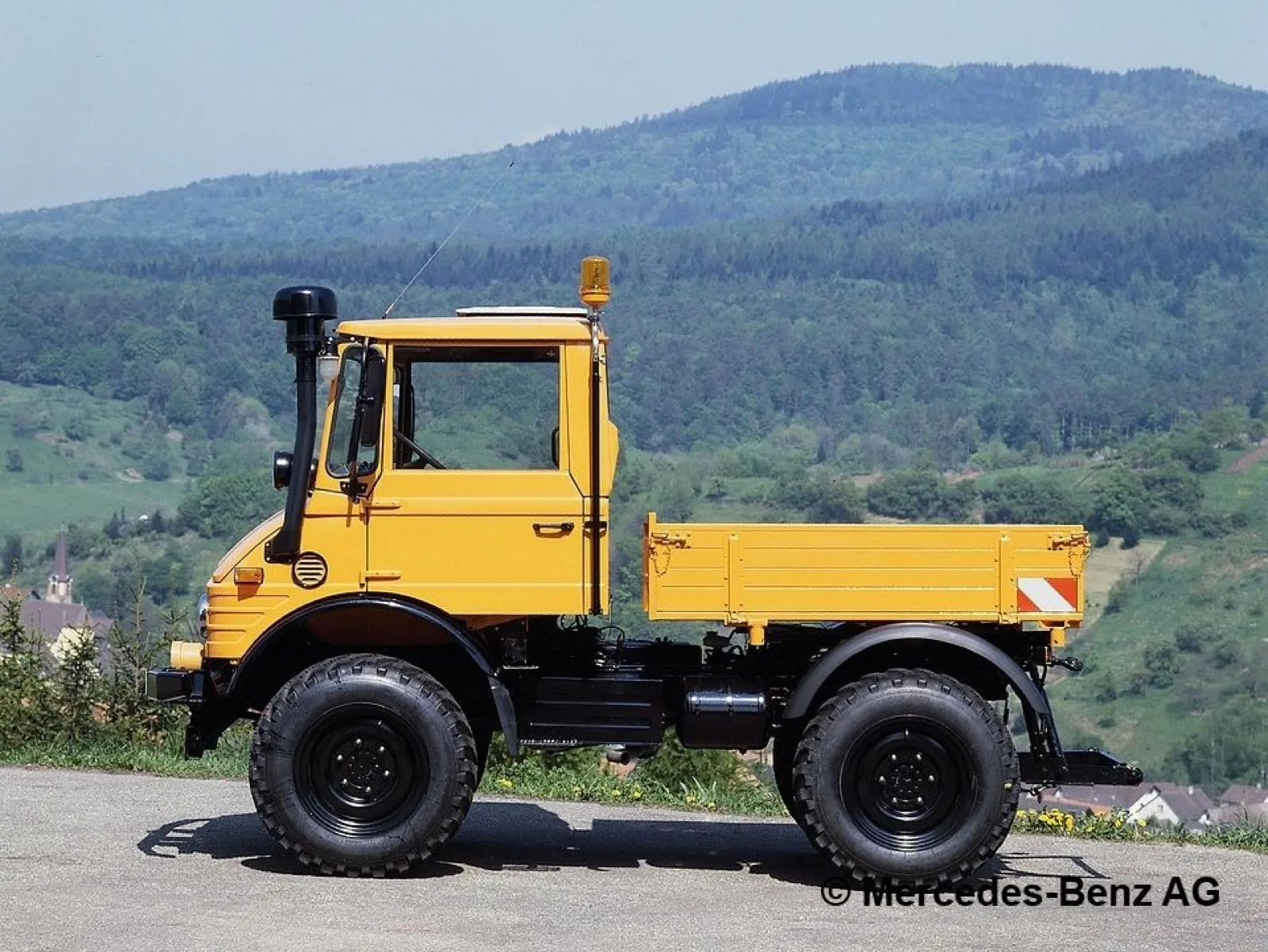
Unimog U600 Cab
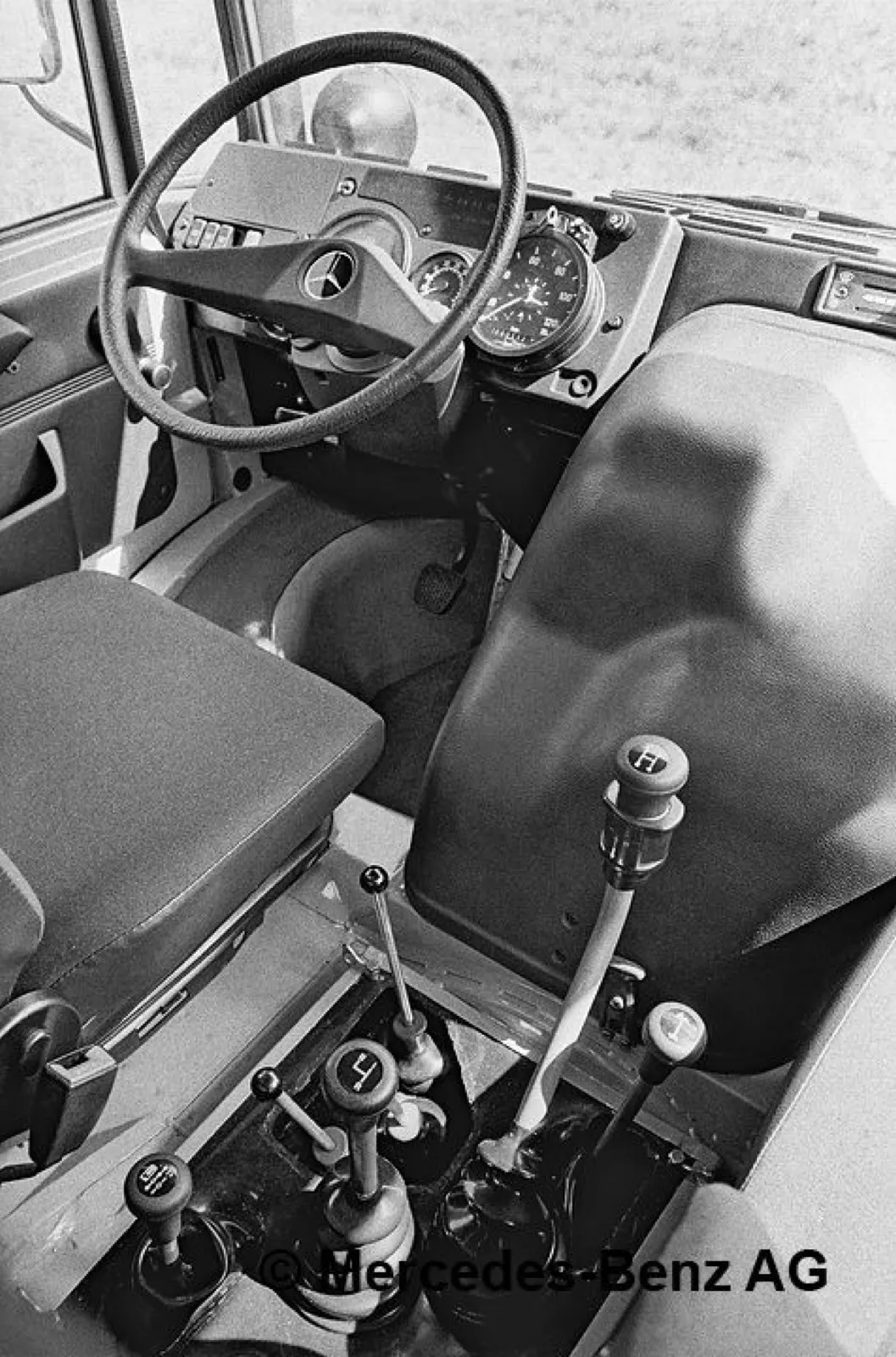
Photo credits: Mercedes-Benz AG