Up until the arrival of the 406 series, all Unimog variants had been built around a shared set of components. The original U 2010 and L 401 models had gradually evolved into an entire family of vehicles. From 1963, the Unimog range was therefore expanded with the new 406 series, which was very much in the interest of bodywork manufacturers.
The wheelbase of this new Mercedes-Benz Unimog was 2,380 mm.
The U 406 remained faithful to the original concept and the technical building blocks of earlier versions. After three years, the U 65 was replaced by the U 70, which in turn gave way to the U 80. From 1971, a top-of-the-range model was also added to the line-up with the U 84.
The 406 — the best-selling Unimog
Although the Unimog 406 went through several updates over its lifetime, it remained on sale for 18 years, right through to the end of 1989. The 406.120 and 406.121 models accounted for 96% of all U 406s ever built.
The 65 hp engine of the Unimog 406
At the same time, more powerful diesel engines began to appear under the short bonnet of the Unimog 406. The 65 hp of a four-cylinder unit, soon matched by the legendary large-displacement six-cylinder OM 312 diesel (5.7 litres), set a new benchmark for engine output. This new Unimog was called the U 65.
Mercedes’ objectives with the U 406
The new 406 series focused on the engine, cab, transmission, axles, tool-mounting options, chassis and axle loads. The proven Unimog assemblies were to be largely adopted or retained.
The chassis was redesigned to accommodate the longer 2,380 mm wheelbase, the higher permissible weights and the significantly greater engine output. The axles were optimised and the transmission was adapted to handle the increased power.
Three cab types with three-point suspension were specified in the design brief:
- folding soft top,
- all-steel cab,
- all-steel double cab.
In the early stages, cab production was constrained by manufacturing capacity. An all-steel cab required at least a 1,000-tonne hydraulic press in the Gaggenau press shop, which was not yet available in the early 1960s.
Many specifications and figures changed over the course of production, adapted to the wishes of customers and equipment manufacturers.
With the 406 series, Daimler-Benz rounded out its range with a genuinely versatile vehicle capable of on-road and off-road use, opening up entirely new possibilities for the Mercedes-Benz Unimog.
Variants and model codes
| Model | Name | Cab type | Wheelbase | Power (hp) | Engine |
|---|---|---|---|---|---|
| 406.120 | U900, U70, U80, U84, U65 | Open cab | 2380 mm | 65/70/80/84 | OM 352 |
| 406.120 | U65 | Open cab | 2380 mm | 65 | OM 312 |
| 406.121 | U900, U70, U80, U84, U65 | Closed cab | 2380 mm | 65/70/80/84 | OM 352 |
| 406.121 | U65 | Closed cab | 2380 mm | 65 | OM 312 |
| 406.130 | U65 T, U70 T | Open cab | Tractor head | 70 | OM 352 |
| 406.130 | U65 T, U70 T | Open cab | Tractor head | 65 | OM 312 |
| 406.131 | U65 T, U70 T | Closed cab | Tractor head | 70 | OM 352 |
| 406.131 | U65 T, U70 T | Closed cab | Tractor head | 65 | OM 312 |
| 406.133 | U80 T | Open cab | Tractor head | 80 | OM 352 |
| 406.140 | Open cab | 2900 mm | 100 | OM 352 | |
| 406.141 | Closed cab | 2900 mm | 100 | OM 352 | |
| 406.142 | U900, U84, U100 | Open cab | 2380 mm | 84/100/110 | OM 352 |
| 406.143 | U900, U84, U100 | Closed cab | 2380 mm | 84/100/110 | OM 352 |
| 406.145 | U900, U84 | Closed cab | 2380 mm | 84 | OM 352 |
| 406.170 | |||||
| 406.171 | |||||
| 406.200 | Open cab | 2900 mm | 100/110 | OM 352 |
Unimog U65
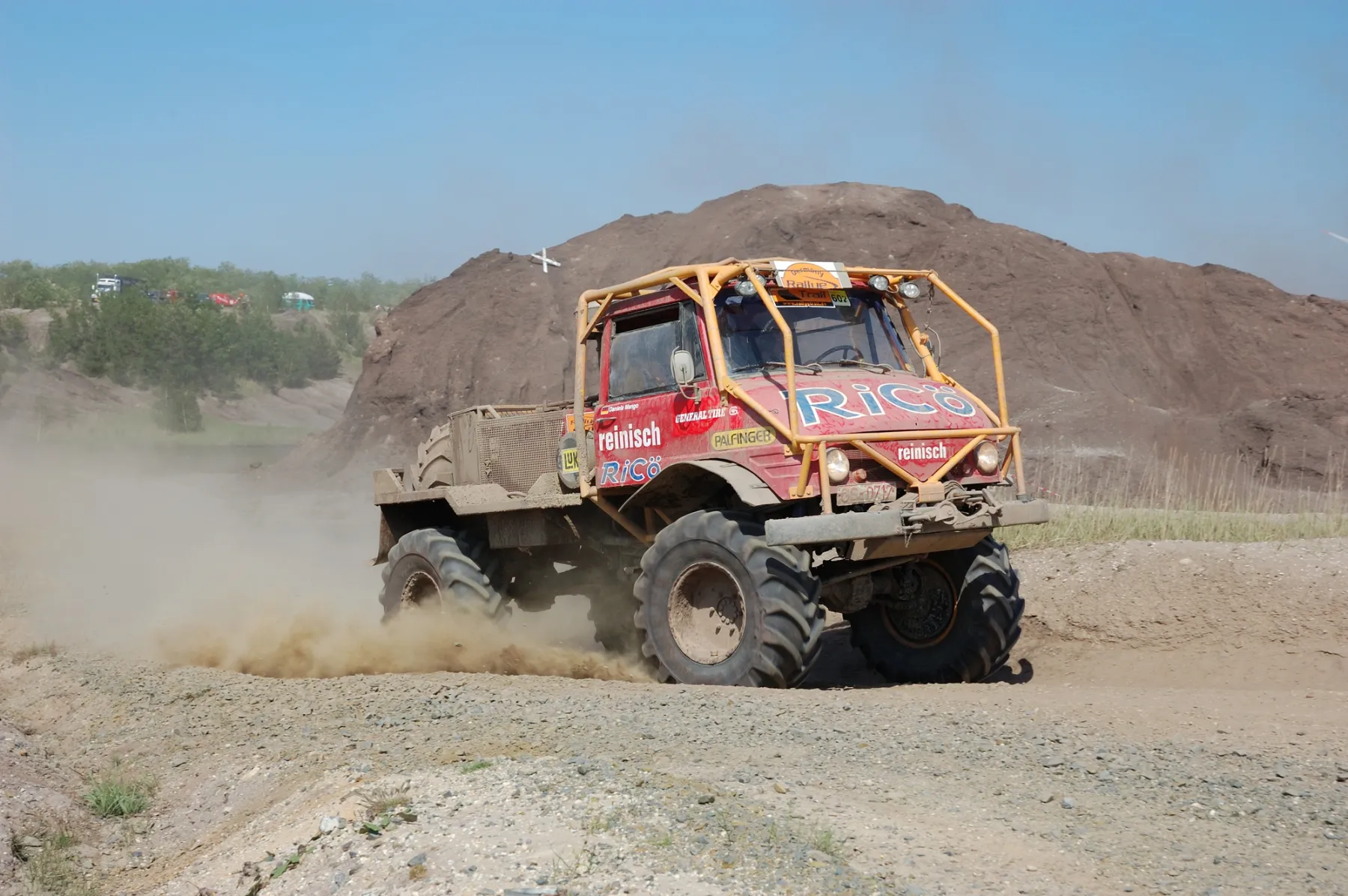
Unimog U70T
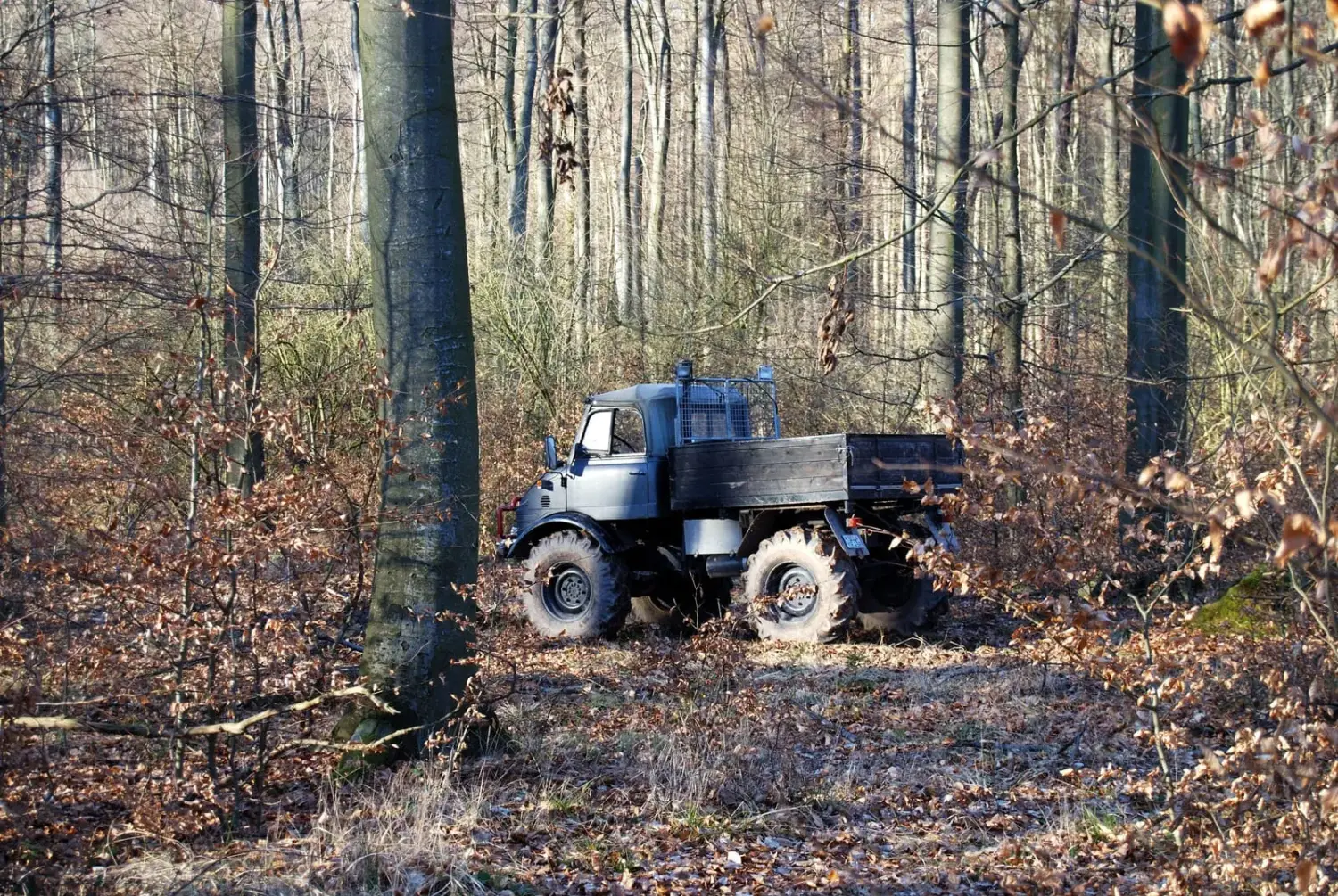
Unimog U84
Unimog U900
Photo credits: Mercedes-Benz AG