Mercedes launched the Unimog U54, the first model in the 403 series, in April 1966. The first model of the 413 series followed in 1969 with the U80, which was later renamed U800L.
The Unimog 403 series
The U54, U66 and U72 were the three models Mercedes presented during the lifetime of the 403 series.
The Unimog U54 — key features
Visually, the U54 is very close to the 406 series:
- a wheelbase of 2,380 mm,
- a short-bonnet cab with a revised grille, offering an excellent view of the road and any front-mounted attachments,
- wider doors with a step behind the front wheel,
- a raised driving cab that greatly simplified access to the engine and drivetrain for maintenance and repair work.
It was available either as an open cab with an all-weather folding hood, or as an all-steel closed cab with large windows and a practical, work-focused standard fit. This included hot-water and fresh-air heating, windscreen ventilation and defrosting, and comfortable seating. Behind the driver’s cab, an easily removable auxiliary loading platform sat on four ball joints, with the spare wheel stowed beneath it.
Off-road performance
The U54 is highly capable off-road. It can safely cross obstacles and dense vegetation. The axle tube and differential were positioned above the centre of the wheel, allowing for exceptionally high ground clearance while keeping the centre of gravity relatively low. The front and rear axles were also identical.
Engine and gearbox of the U54
Six different gearbox configurations were available.
As the name suggests, the U54 was fitted with a 54 hp diesel engine. The 403 series used the four-cylinder OM 314 engine.
The Unimog U66, launched in 1969
The main addition on the U66, beyond its engine output raised to 66 hp, was disc brakes on all four wheels.
Various equipment options were available on the U66, covering:
- the transmission,
- the special power take-off,
- pneumatic and hydraulic equipment,
- the frame and chassis,
- the engine and instrumentation.
The U72 arrives in 1976
The increase in engine output led to a new designation for this variant with the U72. It is worth noting that following the renumbering system, it subsequently became the U800.
An ever-growing range of optional equipment was offered, including:
- a hydraulic system with a dual control valve,
- front and rear power sockets,
- rear lift with three-point hitch,
- a drawbar rail and a Servotrak (mechanical wheel-pressure booster),
- 14.5-20/10 PR tyres recommended for agricultural and forestry use.
Unimog series 413
The 413 series had a longer wheelbase than the 403, which effectively made these Unimogs proper four-wheel-drive trucks.
The U80, later renamed U800L
The 413 series with the U80 was available in a standard version with a two-seat folding-roof cab, three-point adjustable-height suspension, and a full steel cab. Sharing the exterior styling and technical characteristics of the Unimog 416 series but fitted with a 72 hp four-cylinder direct-injection diesel engine, the U80 (U800L) was primarily intended to serve as a long-wheelbase (2,900 mm) all-terrain four-wheel-drive truck.
The U80 or U800L could be registered as either a truck or a tractor. Classification as a truck came with a reduced trailer load allowance. A truck was required to have 6 hp per tonne of gross weight, while a tractor only needed 3 hp — the choice depended on the intended use. As a truck, higher road speeds were permitted in some circumstances, whereas a tractor could pull two trailers, which was useful for farmers and fairground operators but was not allowed for trucks.
The 413 series Unimogs looked very similar to the 416 series. The only distinguishing feature was the four-cylinder engine, for which the factory quoted an output of 72 hp. Sales of the 413 series remained very limited. This can be explained by the arrival of a new generation of Unimogs — the angular-looking 424, 425 and 435 series.
Variants and model codes
| Model | Name | Cab type | Wheelbase | Power (hp) | Engine |
|---|---|---|---|---|---|
| 403.120 | U54, U54 A, U54 F, U54 L | Open cab | 2380 mm | 54 | OM 314.916 |
| 403.121 | U54, U54 A, U54 F, U54 L | Closed cab | 2380 mm | 54 | OM 314.916 |
| 403.122 | U66, U66 A, U66 F, U66 L | Open cab | 2380 mm | 66 | OM 314.917 |
| 403.123 | U66, U66 A, U66 F, U66 L | Closed cab | 2380 mm | 66 | OM 314.917 |
| 403.122 | U800, U800 A, U800 F, U800 L | Open cab | 2380 mm | 72 | OM 314.917 |
| 403.123 | U800, U800 A, U800 F, U800 L | Closed cab | 2380 mm | 72 | OM 314.917 |
| Model | Name | Cab type | Wheelbase | Power (hp) | Engine |
|---|---|---|---|---|---|
| 413.110 | U72, U80, U800 L | Open cab | 2900 mm | 72/80 | OM 314 |
| 413.111 | U72, U80, U800 L | Closed cab | 2900 mm | 72/80 | OM 314 |
Unimog U54
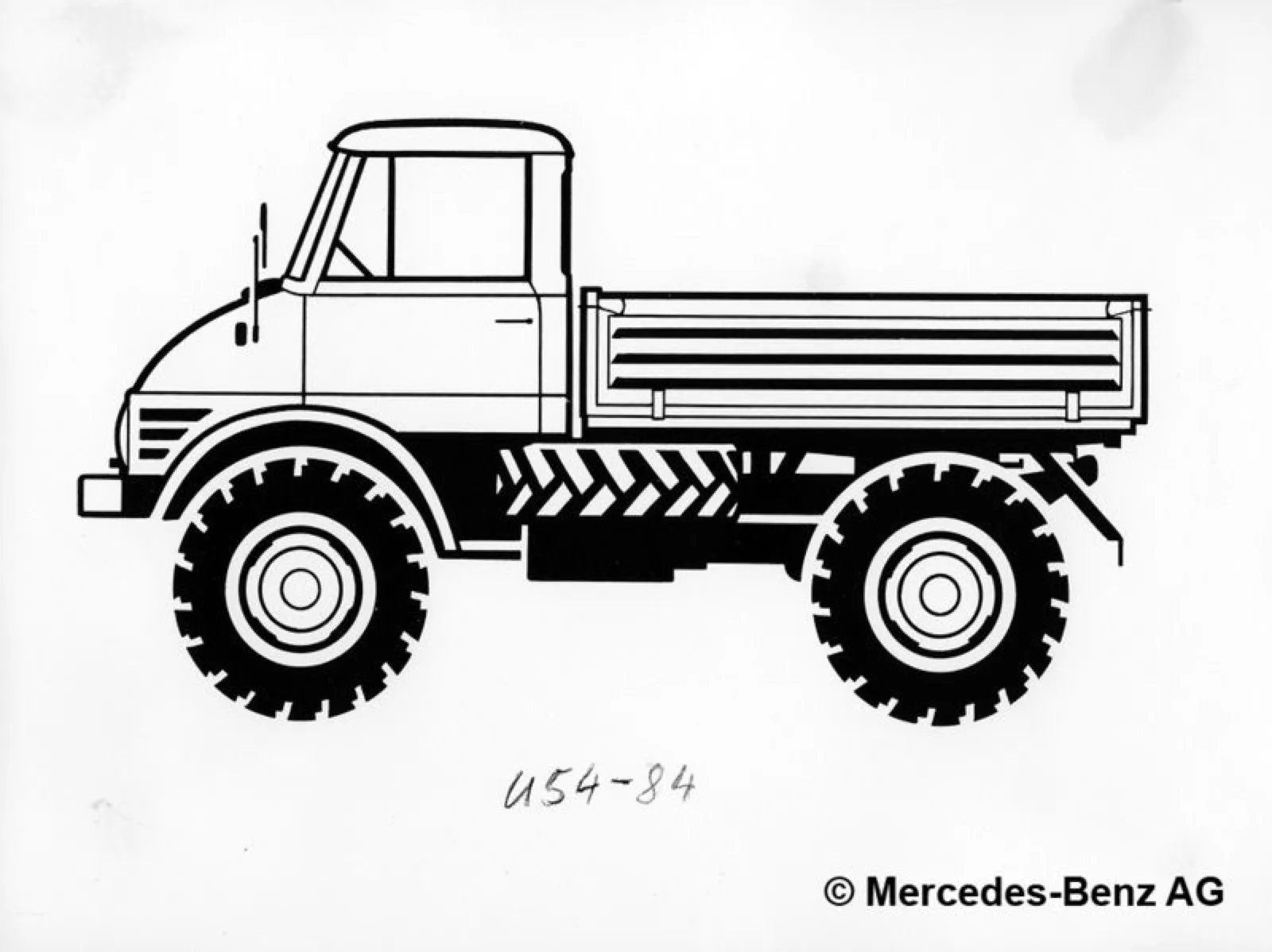
Unimog U54
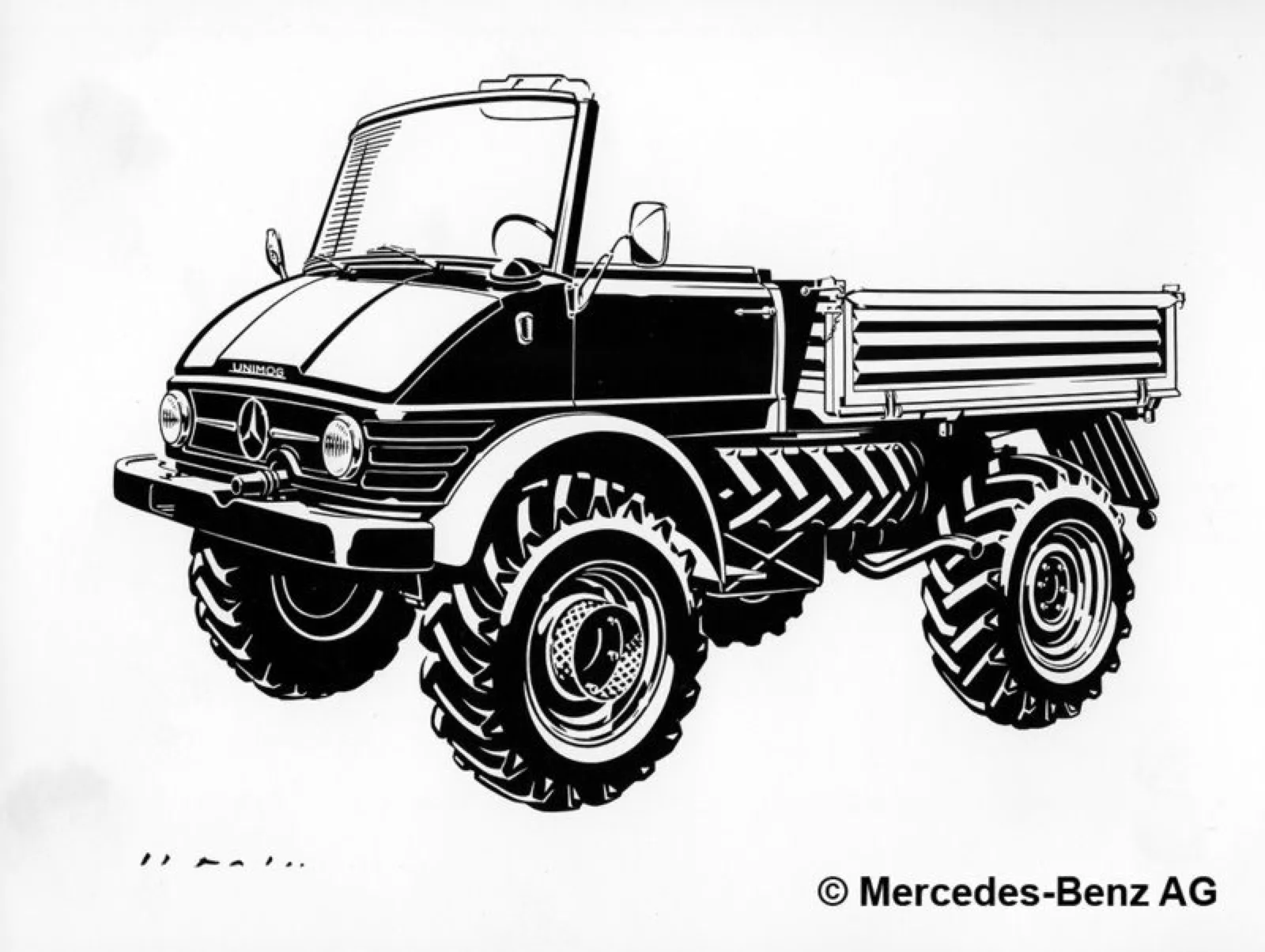
Photo credits: Mercedes-Benz AG