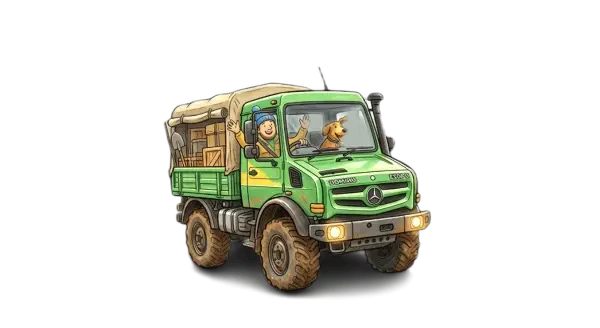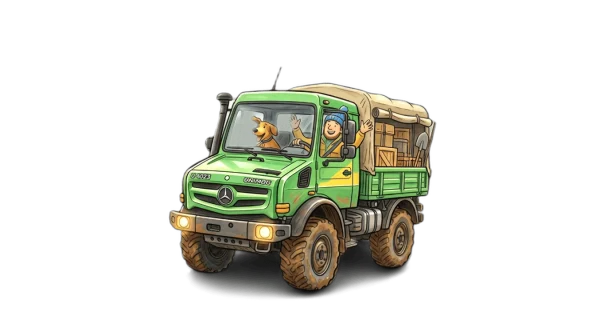
The 416 series entered production in 1965 and was based on the 406 series, from which it differed by offering a longer wheelbase of 2,900 mm or 3,400 mm compared to the 406’s 2,380 mm. This enabled longer bodywork and higher payload capacities. The Unimog U416 remained in production until 1994, with a total of 45,544 units built across 21 variants. The 416 series chassis were also used as the base for special-purpose vehicles by other manufacturers.
The 416 as a semi-trailer tractor
Thanks to the fitment of a fifth-wheel coupling, the short-wheelbase Unimog 416 could now be used as a semi-trailer tractor, which had not been possible with the Unimog 406 due to its shorter wheelbase.
The long-wheelbase chassis was primarily reserved for use as a working machine with specialist tasks, such as a carrier for large mounted implements or as an all-terrain truck.
Equipment on the Unimog 416
The U 416 could be delivered with many of the same equipment details as the U 406.
At the rear, the U 416 offered two chassis overhangs: 425 mm and 905 mm. The short chassis overhang mirrored that of the U 406, while the long chassis overhang was aimed at customers requiring special bodywork, such as fire services.
The short overhang provided space between the driver’s cab and the loading platform for crane superstructures, winches or large toolboxes, thanks to more favourable load distribution. This free space was of course also ideal for a five-seat double cab. With the short chassis overhang (425 mm), a fifth-wheel coupling was available, as the long wheelbase of the U 416 offered greater driving and manoeuvring stability than the U 406.
Unimog U80
Compared to the 406, the key change on the 416 U80 was the extension of the wheelbase by 520 mm to reach 2,900 mm. The new Unimog 416 series was available in two chassis lengths: short (4,207 mm) and long (4,687 mm).
The first open and closed cab models were fitted with the 80 hp six-cylinder direct-injection diesel engine, type OM 352 (BM 353.902).
Unimog U90
The U 90 replaced the U 80 in January 1969. It was regarded as a powerful and agile tractor for short-distance freight transport.
The U 90 was fitted with the six-cylinder OM 352 diesel engine with direct injection, derived from the engine used in heavy-duty trucks. It developed a maximum output of 126 hp, reduced to 90 hp at 2,800 rpm in the U 90.
Unimog U100 and U110
In 1969, Daimler-Benz launched the Unimog U 100. With its 100 hp output, the vehicle met the demands of short-distance freight transport. It was designed for short-haul haulage and factory towing operations.
The U100 also featured the characteristics of the 416 series: its wheelbase was extended to 2,900 mm to accommodate a semi-trailer coupling, a double cab or special working equipment. The 100 hp version of the Unimog 416 series remained in the line-up only until the end of 1970, when it was replaced by the U 110 with output raised to 110 hp.
This marked the first time the Unimog was made available as a chassis variant in a so-called truck configuration.
The 100 hp Unimog 416 was not only used as a road tractor, working machine or tool carrier — it was also increasingly deployed in international military operations as a light all-terrain truck in the NATO class, where it was preferred over the Unimog S for its diesel engine.
The 416 was approved as a medium transport vehicle and tractor for hauling loads of up to 2.5 tonnes (up to 3.0 tonnes with the 3,400 mm wheelbase). Its 90-litre fuel tank gave a range of up to 600 km on road, at a consumption of around 19 litres per 100 km.
U1100 L — the off-road specialist
The U 1100 L, model 416.114 of the 416 series, is a powerful all-terrain vehicle and one of the most capable commercial vehicles ever built. Its off-road ability, combined with its robustness and reliability, is remarkable. Its high-performance chassis is characterised by low weight, excellent driving stability, a cranked frame and a large tyre contact patch with maximum possible axle articulation.
The U 1100L is agile and, at its relatively low weight, almost comparable to a four-wheel-drive passenger vehicle. The 12.5-20/10 PR wheels are also enormous in comparison and well suited to off-road use. The U 1100 L is the most frequently built variant in the 416 series.
New designations for the 416 series
From the mid-1970s, the 416 series also received new sales designations, now based on the rounded value of the engine’s output multiplied by ten. The U 100 with a 2,900 mm wheelbase became the U 1100, receiving the designations BM 416.140 (folding soft top) and 416.141 (all-steel cab).
The U 100 chassis variant became the U 1100 L, while the open-top U 100 L became the BM 416.114.
Variants and model codes
| Model | Name | Cab type | Wheelbase | Power (hp) | Engine |
|---|---|---|---|---|---|
| 416.114 | U100, U110, U1100 L | Open cab | 2900 mm | 100/110 | OM 352 |
| 416.115 | U100, U110, U1100 L | Closed cab | 2900 mm | 100/110 | OM 352 |
| 416.116 | U100, U110, U1100 L | Open cab | 3400 mm | 100/110 | OM 352 |
| 416.117 | U100, U110, U1100 L | Closed cab | 3400 mm | 100/110 | OM 352 |
| 416.122 | U80, U90 | Open cab | 2900 mm | 80/90 | OM 352 |
| 416.123 | U80, U90 | Closed cab | 2900 mm | 80/90 | OM 352 |
| 416.124 | U80, U90 | Open cab | 2900 mm | 80/90 | OM 352 |
| 416.125 | U80, U90 | Closed cab | 2900 mm | 80/90 | OM 352 |
| 416.126 | U80, U90 | Open cab | 2900 mm | 80/90 | OM 352 |
| 416.1127 | U80, U90 | Closed cab | 2900 mm | 80/90 | OM 352 |
| 416.130 | U80 T, U90 T | Open cab | Tractor head | 80/90 | OM 352 |
| 416.133 | U80 T, U90 T | Closed cab | Tractor head | 80/90 | OM 352 |
| 416.134 | U100 T, U110 T, U1100 T | Open cab | Tractor head | 100/110 | OM 352 |
| 416.135 | U100 T, U110 T, U1100 T | Closed cab | Tractor head | 100/110 | OM 352 |
| 416.140 | U100, U110, U1100 L | Open cab | 2900 mm | 100/110 | OM 352 |
| 416.141 | U100, U110, U1100 L | Closed cab | 2900 mm | 100/110 | OM 352 |
| 416.160 | |||||
| 416.162 | U1100 L, U125 | Open cab | 2900 mm | 125 | OM 352 |
| 416.163 | U1100 L, U125 | Closed cab | 2900 mm | 125 | OM 352 |
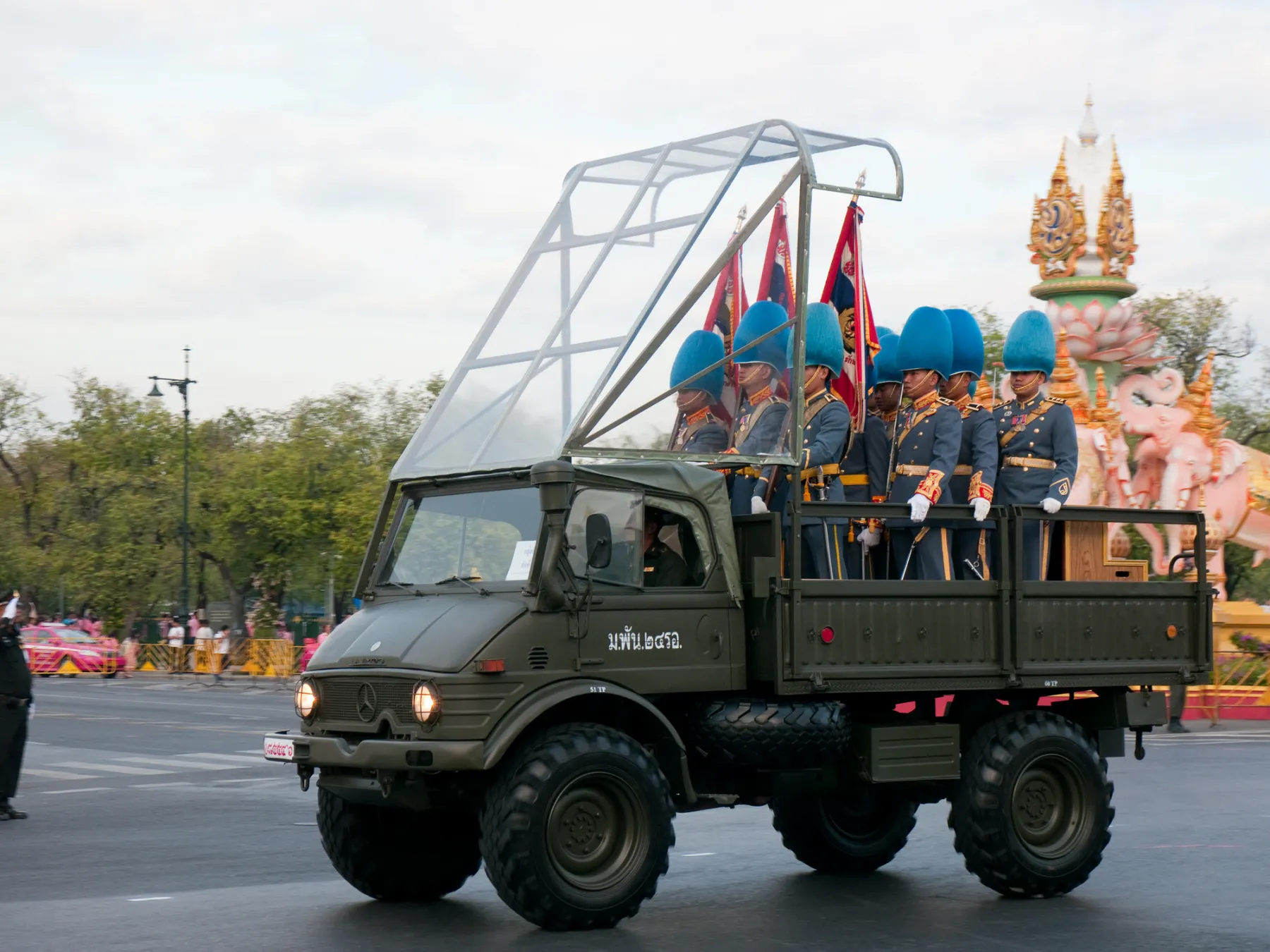
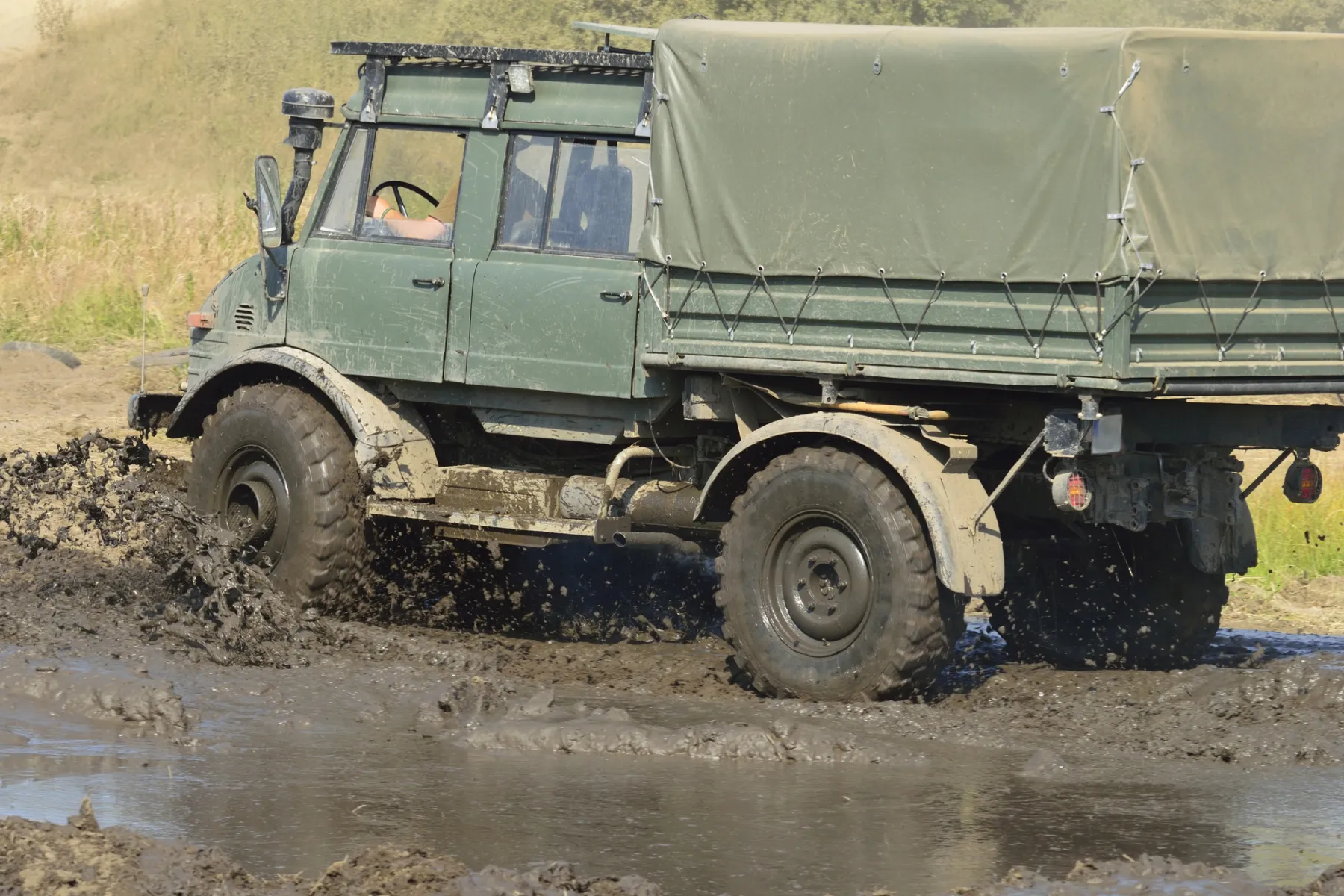
Unimog series 416 — photo gallery
Photo credits: Mercedes-Benz AG